
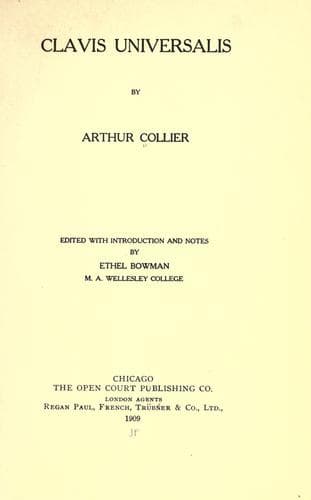
Clavis Universalis
المفتاح الشامل
Editorial summary
Arthur Collier's Clavis Universalis presents a rigorous philosophical demonstration that the external world does not exist independently of perception, advancing a position of absolute idealism that bears striking similarity to George Berkeley's contemporaneous work, though developed independently. Writing in the early eighteenth century amid debates between Cartesian rationalism and Lockean empiricism, Collier employs a systematic dialectical method to prove what he terms the "non-existence or impossibility of an external world."
The work proceeds through two main argumentative strategies. First, Collier demonstrates that the concept of an external, mind-independent material world generates irresolvable contradictions when subjected to philosophical analysis. He examines paired opposites—finite and infinite, divisible and indivisible, movable and immovable—showing that matter must possess contradictory properties simultaneously, which violates the principle of non-contradiction. Second, he argues positively that all perceived qualities exist only as modifications of mind, making the postulation of external material substance both unnecessary and incoherent.
Collier's philosophical method combines elements of scholastic argumentation with the geometric reasoning popularized by Descartes and Spinoza. Unlike Berkeley, who grounds his idealism primarily in empiricist principles about the nature of perception, Collier builds his case through pure rational analysis, demonstrating the logical impossibility of matter's independent existence. This approach allows him to sidestep epistemological questions about how we know the external world, focusing instead on the ontological question of whether such a world can coherently exist.
The work's significance for debates about God emerges through Collier's treatment of causation and perception. By denying material substance, Collier makes God the immediate cause of all perceptions, positioning divine activity as the sole explanatory principle for phenomenal experience. This move radicalizes occasionalist themes from Malebranche while avoiding pantheistic implications by maintaining a clear distinction between divine substance and finite minds.
Collier's idealism represents a crucial moment in early modern philosophy's engagement with theism. By eliminating material substance, he creates a metaphysical framework where God's continuous creative activity becomes not merely compatible with philosophical reason but demanded by it. The Clavis Universalis thus demonstrates how rigorous philosophical analysis could serve apologetic purposes, using skeptical arguments about matter's existence to establish God's immediate presence in all experience.
Argument formulations engaged
Related works
Collier, Arthur (1713). Clavis Universalis. Fondo de Cultura Economica.
@book{clavis-universalis-1713,
  author    = {Collier, Arthur},
  title     = {Clavis Universalis},
  year      = {1713},
  publisher = {Fondo de Cultura Economica},
  url       = {https://god-database.com/en/works/clavis-universalis-1713}
}