
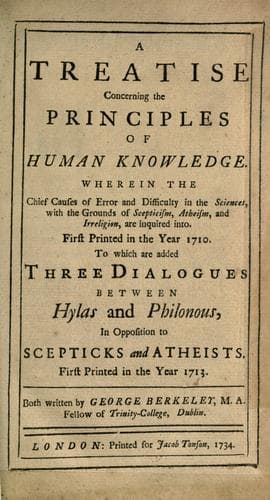
A Treatise concerning the Principles of Human Knowledge
رسالة في مبادئ المعرفة الإنسانية
Traité sur les Principes de la Connaissance Humaine
Editorial summary
Berkeley's A Treatise concerning the Principles of Human Knowledge presents one of the most audacious defenses of theism in early modern philosophy through its radical immaterialist metaphysics. The work argues that material substance does not exist independently of perception, and that all reality consists solely of minds and their ideas. This seemingly counterintuitive position serves as the foundation for Berkeley's ingenious argument that God's existence is not merely probable but absolutely necessary for the coherence of human experience.
The treatise systematically dismantles the materialist philosophy that Berkeley sees as the root of both skepticism and atheism. He contends that philosophers like Locke, who maintain a distinction between primary and secondary qualities while positing an unknowable material substratum, inadvertently open the door to religious doubt. By accepting that objects exist independently of perception, materialists create an unnecessary gap between mind and world that skeptics exploit to question all knowledge, including knowledge of God. Berkeley's solution is breathtakingly simple: eliminate matter entirely, and with it, the epistemological problems that fuel religious skepticism.
Berkeley's positive argument for God emerges from his analysis of the continuity and regularity of sensory experience. If esse est percipi (to be is to be perceived), then the persistence of objects when no finite mind perceives them requires an infinite mind that perpetually perceives all things. The orderly succession of ideas that constitutes natural laws similarly demands a supreme intelligence as its cause. Unlike finite minds that perceive passively, God actively produces the ideas that constitute the sensible world, making divine existence as certain as the existence of sensory experience itself.
The work's theological significance extends beyond mere proof of God's existence. Berkeley argues that immaterialism brings humans closer to God by eliminating the material intermediary between divine action and human perception. Every sensory experience becomes a direct communication from God, making atheism not just false but incoherent. The treatise thus transforms what might seem like philosophical idealism into a profound theological realism where God's immediate presence pervades all experience. While Berkeley's system faced immediate criticism for its apparent violation of common sense, his argument remains one of the most philosophically rigorous attempts to demonstrate that belief in God is not merely reasonable but rationally unavoidable.
Argument formulations engaged
Related works
Berkeley, George (1710). A Treatise concerning the Principles of Human Knowledge. The University of Adelaide Library.
@book{a-treatise-concerning-the-principles-of-,
  author    = {Berkeley, George},
  title     = {A Treatise concerning the Principles of Human Knowledge},
  year      = {1710},
  publisher = {The University of Adelaide Library},
  url       = {https://god-database.com/en/works/a-treatise-concerning-the-principles-of-human-knowledge-1710}
}