
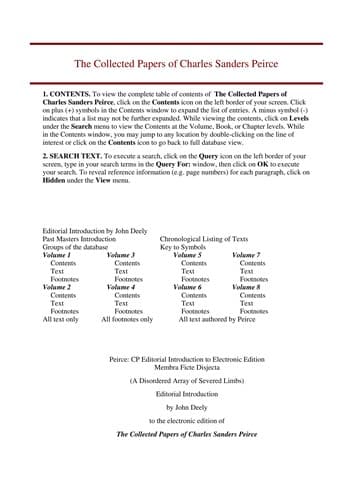
Collected Papers of Charles Sanders Peirce
الأوراق المجمعة لتشارلز ساندرز بيرس
Œuvres complètes de Charles Sanders Peirce
Editorial summary
The eight-volume Collected Papers of Charles Sanders Peirce presents the most comprehensive assembly of writings from one of America's most original philosophers, whose engagement with the question of God emerges through his unique synthesis of logic, semiotics, and pragmatism. Published posthumously between 1931 and 1958, these papers reveal Peirce's evolving thought on religious matters as integral to his philosophical system rather than peripheral to it.
Peirce's approach to God differs markedly from both traditional natural theology and the skeptical empiricism of his era. His pragmatic maxim - that the meaning of a concept lies in its conceivable practical effects - transforms theological inquiry from abstract speculation into an examination of how religious belief functions in human experience and scientific practice. Throughout the papers, Peirce develops his notion of "musement," a form of pure play of ideas that he argues naturally leads to the hypothesis of God's reality when properly pursued.
Central to Peirce's religious thought is his evolutionary cosmology, which posits that the universe develops from chaos toward increasing reasonableness through the operation of three fundamental categories: Firstness (spontaneity), Secondness (brute reaction), and Thirdness (mediation and law). God emerges in this framework not as a static first cause but as the ultimate attractor toward which cosmic evolution tends. His famous "Neglected Argument for the Reality of God" contends that sincere contemplation of the universe's orderliness naturally generates belief in a divine reality, though this argument operates through abductive rather than deductive logic.
Peirce's semiotics provides another avenue for theological reflection. His theory of signs, wherein all thought and reality involve triadic relations of sign, object, and interpretant, suggests that the universe itself may be understood as God's continuous communication. This semiotic theology avoids both crude anthropomorphism and abstract deism, presenting divinity as actively present in the universe's intelligible structure.
The papers also reveal Peirce's critical engagement with contemporaries like William James, whose individualistic approach to religious experience Peirce found insufficiently attentive to religion's communal and rational dimensions. Against the materialism of his age, Peirce maintains that mechanical explanations cannot account for the universe's tendency toward habit-formation and reasonableness, phenomena that point toward divine purpose. His contributions establish a distinctive American voice in philosophical theology, one that remains influential in contemporary discussions of science and religion.
Argument formulations engaged
Related works
Peirce, Charles Sanders (1931). Collected Papers of Charles Sanders Peirce. University of Chicago Press.
@book{collected-papers-of-charles-sanders-peir,
  author    = {Peirce, Charles Sanders},
  title     = {Collected Papers of Charles Sanders Peirce},
  year      = {1931},
  publisher = {University of Chicago Press},
  url       = {https://god-database.com/en/works/collected-papers-of-charles-sanders-peirce-1931}
}