
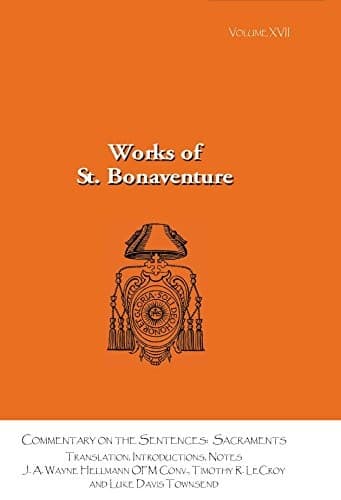
Commentary on the Sentences
شرح الجمل
Commentaire sur les Sentences
Editorial summary
Bonaventure's Commentary on the Sentences represents a pivotal contribution to 13th-century scholastic theology, systematically defending the coherence of Christian theism through philosophical argumentation. Written during his time as a bachelor at the University of Paris between 1250 and 1252, this extensive work engages with Peter Lombard's Sentences while developing distinctive positions on divine knowledge, creation, and the relationship between faith and reason.
The Commentary advances a fundamentally Augustinian approach to the God question, though one thoroughly informed by Aristotelian philosophy. Bonaventure argues that human knowledge of God derives from both natural reason and divine illumination, positioning himself against purely rationalistic approaches while maintaining philosophy's legitimate role in theological inquiry. His treatment of divine existence employs multiple demonstration strategies, including arguments from motion, causation, and degrees of perfection, yet consistently emphasizes that such proofs require the light of faith for their full comprehension.
Central to Bonaventure's theological method is his doctrine of exemplarism, which presents creation as bearing the vestiges of its divine creator. This framework enables him to argue that all creatures point toward God as their exemplar cause, making the natural world itself a kind of argument for divine existence. Unlike his contemporary Thomas Aquinas, who would later emphasize the autonomy of natural reason, Bonaventure maintains that human intellect requires divine illumination to achieve certain knowledge of God's existence and attributes.
The work engages critically with Islamic philosophy, particularly Averroistic interpretations of Aristotle that threatened traditional Christian theism. Bonaventure opposes theories of eternal creation and the unity of the intellect, defending instead creation ex nihilo and individual immortality as philosophically demonstrable truths consonant with revealed doctrine. His arguments anticipate later Franciscan critiques of excessive Aristotelianism in theology.
Bonaventure's Commentary matters for the God debate because it exemplifies a sophisticated medieval synthesis that neither reduces theology to philosophy nor abandons rational argumentation. His insistence that reason alone cannot achieve complete knowledge of God, while still affirming reason's capacity to demonstrate divine existence, establishes a nuanced position between fideism and rationalism. The work's influence extends through subsequent Franciscan theology, shaping debates about the respective roles of will and intellect in both divine and human nature, and contributing to the rich plurality of scholastic approaches to natural theology.
Argument formulations engaged
Related works
Bonaventure (1254). Commentary on the Sentences. Franciscan Inst Pubs.
@book{commentary-on-the-sentences-1254,
  author    = {Bonaventure},
  title     = {Commentary on the Sentences},
  year      = {1254},
  publisher = {Franciscan Inst Pubs},
  url       = {https://god-database.com/en/works/commentary-on-the-sentences-1254}
}