
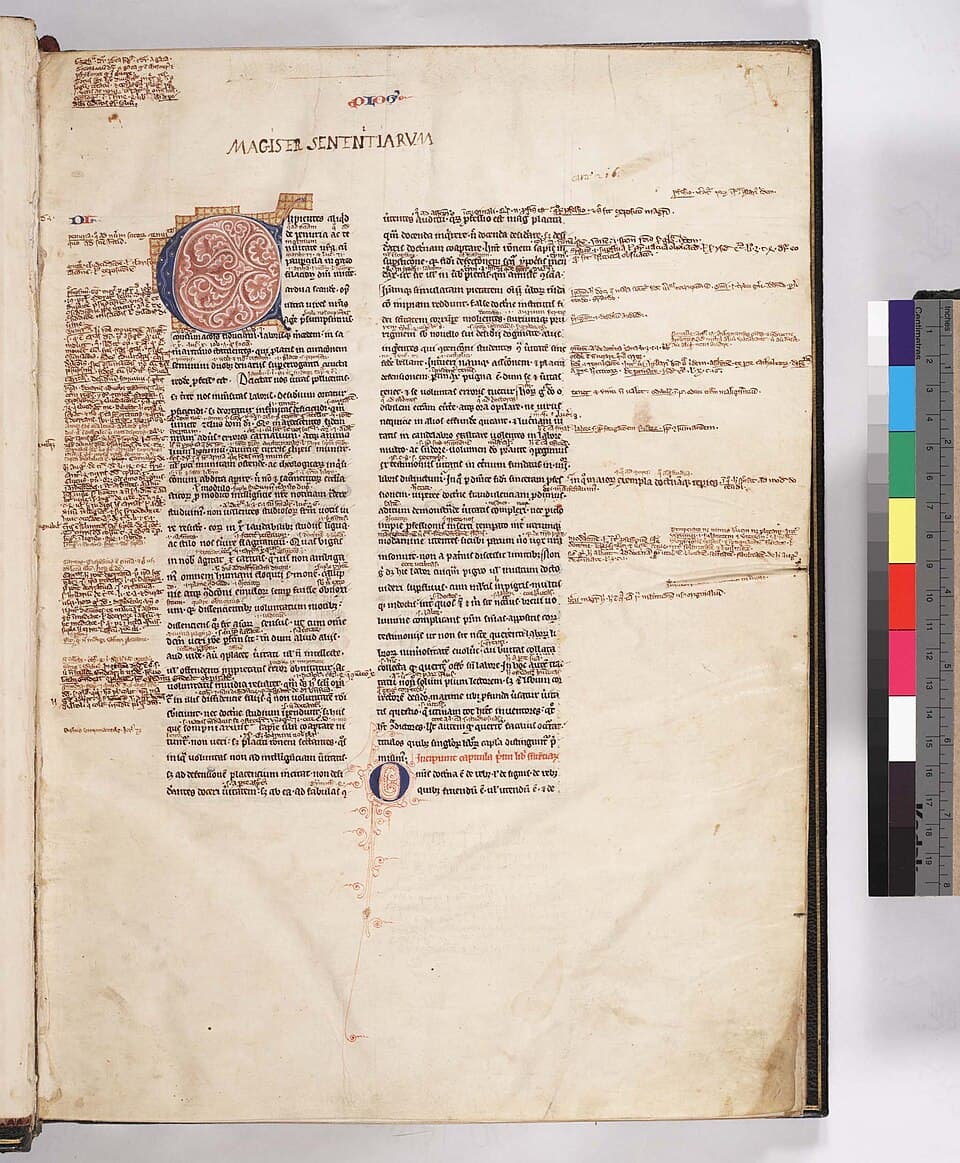
Commentary on the Sentences of Peter Lombard (Scriptum super Sententiis)
تعليق على جمل بطرس لومبارد
Commentaire sur les Sentences de Pierre Lombard
Editorial summary
Thomas Aquinas's Commentary on the Sentences of Peter Lombard represents a foundational work in medieval scholastic theology that systematically develops a philosophical framework for understanding God's existence, nature, and relationship to creation. Written between 1252 and 1256 during Aquinas's early teaching career at the University of Paris, this extensive commentary engages with Lombard's four books of Sentences while establishing many arguments that would later appear in refined form in the Summa Theologica.
The work demonstrates Aquinas's innovative synthesis of Aristotelian philosophy with Christian theology, particularly in his treatment of God's existence and attributes. In the first book's discussions, Aquinas develops sophisticated proofs for God's existence based on motion, causation, and contingency, while addressing the problem of how finite human intellect can comprehend the infinite divine nature. His analysis employs the via negativa (way of negation) and analogical predication to explain how theological language functions when speaking about God.
Against both the radical Aristotelians who would separate philosophy from theology and the conservative Augustinians who rejected Aristotelian methods, Aquinas argues for the complementarity of faith and reason. He maintains that natural reason can establish certain truths about God, such as existence and unity, while revealed truths like the Trinity remain accessible only through faith. This position challenges the fideism of some contemporaries while avoiding the rationalism that would subordinate revelation to philosophy.
The commentary's treatment of divine simplicity, omnipotence, and providence establishes crucial distinctions that shape subsequent theological debate. Aquinas argues against anthropomorphic conceptions of God while defending divine personality and agency. His discussion of how God knows future contingents and how divine causation relates to human freedom provides sophisticated solutions to perennial theological problems.
The work's significance extends beyond its immediate scholastic context. By demonstrating how rigorous philosophical analysis can serve theological understanding, Aquinas establishes a model for rational discourse about God that influences both Catholic theology and broader Western philosophical discussions. His careful distinctions between essence and existence, potency and act, and necessary and contingent being provide conceptual tools that remain influential in contemporary philosophy of religion. The commentary thus represents a major contribution to natural theology and the project of faith seeking understanding.
Argument formulations engaged
Related works
Aquinas, Thomas (1256). Commentary on the Sentences of Peter Lombard (Scriptum super Sententiis).
@book{commentary-on-the-sentences-of-peter-lom,
  author    = {Aquinas, Thomas},
  title     = {Commentary on the Sentences of Peter Lombard (Scriptum super Sententiis)},
  year      = {1256},
  url       = {https://god-database.com/en/works/commentary-on-the-sentences-of-peter-lombard-scriptum-super-sententiis-1256}
}