
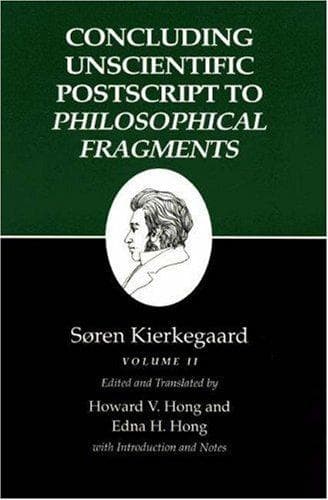
Concluding Unscientific Postscript
خاتمة علمية غير علمية
Post-scriptum définitif non scientifique
Editorial summary
Johannes Climacus, Kierkegaard's pseudonymous author of Concluding Unscientific Postscript, mounts a sustained critique of systematic philosophy's approach to religious truth, particularly targeting Hegelian attempts to demonstrate Christianity through speculative reason. The work argues that objective, scientific approaches to religious questions fundamentally misunderstand the nature of faith, which requires subjective passion and personal decision rather than logical demonstration. Against the prevailing intellectual climate of 1840s Copenhagen, where Hegelian philosophy dominated theological discourse, Climacus insists that the question of God and eternal happiness cannot be resolved through abstract reasoning but only through concrete individual existence.
The text develops its argument through a distinction between objective and subjective truth, contending that religious truth belongs essentially to the sphere of subjectivity. While objective inquiry asks what Christianity is as a historical phenomenon or philosophical system, subjective inquiry asks how the individual relates to Christianity in passionate inwardness. Climacus argues that the objective approach, exemplified by both historical criticism and speculative philosophy, inevitably fails because it seeks to eliminate the very uncertainty that makes faith possible. The infinite qualitative difference between the temporal individual and eternal truth creates an absolute paradox that reason cannot overcome through mediation or synthesis.
Central to the work's contribution is its analysis of existence as the proper medium for engaging religious questions. Climacus argues that abstract thought removes the thinker from existence, creating a false objectivity that obscures the decisive importance of individual choice and commitment. The God-relationship requires risk, decision, and passionate intensity—elements that systematic philosophy necessarily excludes. This critique extends to contemporary Danish Christianity, which Climacus sees as having forgotten what it means to become a Christian by assuming everyone already is one through cultural inheritance.
The postscript's philosophical significance lies in its challenge to rationalist approaches to religious belief, whether in the form of natural theology, historical apologetics, or speculative idealism. By emphasizing the limits of objective knowledge in matters of ultimate concern, Climacus opens space for understanding faith as a mode of existence rather than intellectual assent. This existential approach influenced subsequent philosophy of religion by highlighting the inadequacy of purely theoretical treatments of religious commitment and the irreducible role of subjective appropriation in authentic faith.
Argument formulations engaged
Related works
Kierkegaard, Søren (1846). Concluding Unscientific Postscript. Princeton University Press.
@book{concluding-unscientific-postscript-1846,
  author    = {Kierkegaard, Søren},
  title     = {Concluding Unscientific Postscript},
  year      = {1846},
  publisher = {Princeton University Press},
  url       = {https://god-database.com/en/works/concluding-unscientific-postscript-1846}
}