
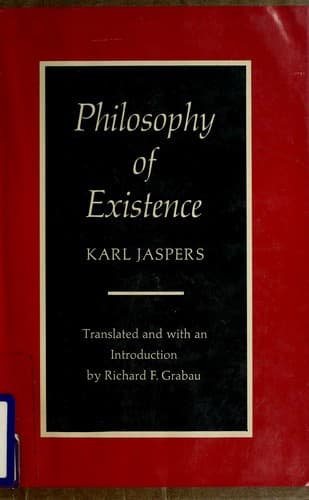
Philosophy
الفلسفة
Philosophie
Editorial summary
This comprehensive philosophical work by Karl Jaspers presents a systematic exploration of philosophy's nature, method, and ultimate concerns, developing themes that bear significantly on questions about transcendence and human understanding of ultimate reality. Writing in the early 1930s amidst European intellectual upheaval, Jaspers articulates a distinctive approach to philosophy that centers on the concept of "Existenz" - authentic human existence characterized by freedom, choice, and confrontation with boundary situations.
Jaspers argues that philosophy differs fundamentally from scientific knowledge, which deals with objects and can achieve universal validity. Philosophy instead concerns itself with Being as such, accessible not through objective investigation but through what he terms "philosophical faith." This faith emerges from existential experiences, particularly in "boundary situations" (Grenzsituationen) such as death, guilt, struggle, and chance, where human beings confront the limits of rational comprehension and worldly security.
Central to Jaspers' contribution to discussions of transcendence is his notion of "the Encompassing" (das Umgreifende) - that which surrounds and exceeds all determinate knowledge and experience. While never directly knowable, the Encompassing manifests through "ciphers" or symbols that point beyond themselves. This framework allows Jaspers to acknowledge transcendent dimensions of reality without committing to traditional metaphysical or theological claims. He explicitly distinguishes philosophical faith from religious faith, arguing that the former remains open to perpetual questioning and resists dogmatic fixation.
The work engages critically with both scientific positivism and traditional metaphysics. Against positivists, Jaspers maintains that reducing reality to scientifically verifiable facts impoverishes human existence and ignores crucial dimensions of meaning. Against metaphysicians, he argues that systematic knowledge of transcendent reality remains impossible, though philosophy can illuminate our relationship to what transcends empirical existence.
Jaspers' methodology combines phenomenological description of consciousness, existential analysis of human situations, and interpretation of philosophical traditions. His approach influences subsequent discussions about the limits of reason, the role of faith in philosophy, and the possibility of non-dogmatic approaches to transcendence. The work's significance for debates about God lies in its sophisticated attempt to preserve space for transcendent meaning while rejecting both atheistic reductionism and traditional theistic certainties, proposing instead a philosophical stance that remains perpetually open to the mystery of Being.
Argument formulations engaged
Related works
Jaspers, Karl (1932). Philosophy. Philosophy Documentation Center.
@book{philosophy-1932,
  author    = {Jaspers, Karl},
  title     = {Philosophy},
  year      = {1932},
  publisher = {Philosophy Documentation Center},
  url       = {https://god-database.com/en/works/philosophy-1932}
}