
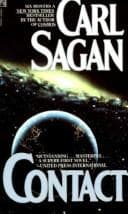
Contact
الاتصال
Editorial summary
Carl Sagan's "Contact" presents a sophisticated exploration of the relationship between scientific inquiry and religious belief through the narrative of humanity's first contact with extraterrestrial intelligence. While ostensibly a work of science fiction, the novel functions as a philosophical meditation on how empirical discovery and transcendent experience might coexist in human understanding.
The work centers on radio astronomer Ellie Arroway, whose detection of an alien signal precipitates both scientific revolution and religious crisis. Sagan constructs his protagonist as an embodiment of scientific rationalism who nonetheless encounters phenomena that challenge purely materialist explanations. Through Arroway's journey, the novel examines whether scientific methodology necessarily excludes religious insight or whether both represent complementary approaches to ultimate questions.
Sagan's treatment of the God question operates on multiple levels. At the surface, he critiques fundamentalist religious responses to scientific discovery, particularly through characters who interpret the alien contact as either divine revelation or satanic deception. However, the novel's deeper engagement concerns the limits of scientific knowledge itself. When Arroway experiences transcendent phenomena during her journey through the alien-constructed transportation device, she confronts the inadequacy of empirical verification for certain forms of truth. Her experience, while subjectively profound, lacks the objective evidence science demands.
The novel's climactic revelation involves the discovery of a message encoded in the fundamental structure of pi, suggesting intentional design at the universe's mathematical foundations. This plot element transforms the work from simple advocacy of scientific materialism into a nuanced consideration of whether the universe exhibits purposeful structure. Sagan thus invites readers to consider whether sufficiently advanced science might discover rather than disprove cosmic intention.
Against the backdrop of 1980s debates between scientific materialism and religious fundamentalism, "Contact" proposes a third way. Rather than asserting either atheistic scientism or traditional theism, Sagan suggests that honest inquiry must remain open to transcendent possibilities while maintaining rigorous standards of evidence. The novel's contribution to the God debate lies in its refusal to reduce the question to simple binaries, instead proposing that both scientific and spiritual impulses stem from humanity's fundamental need to understand its place in the cosmos. Through this synthesis, Sagan challenges both religious believers and scientific materialists to expand their conceptual frameworks.
Argument formulations engaged
Related works
Sagan, Carl (1985). Contact. Simon and Schuster.
@book{contact-1985,
  author    = {Sagan, Carl},
  title     = {Contact},
  year      = {1985},
  publisher = {Simon and Schuster},
  url       = {https://god-database.com/en/works/contact-1985}
}