
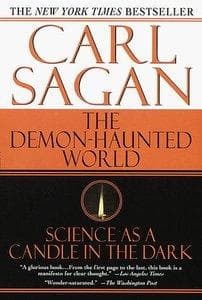
The Demon-Haunted World: Science as a Candle in the Dark
العالم المسكون بالشياطين: العلم كشمعة في الظلام
Le Monde hanté par les démons : La science comme une chandelle dans l'obscurité
Editorial summary
Carl Sagan's The Demon-Haunted World presents a sustained defense of scientific rationalism against what he perceives as rising tides of superstition, pseudoscience, and religious fundamentalism in late twentieth-century America. While not explicitly focused on arguments for or against God's existence, the work articulates a worldview that privileges empirical skepticism over faith-based claims, making it a significant contribution to debates about the relationship between science and religion.
Sagan employs a popularizing approach that combines personal anecdotes, historical examples, and explanations of scientific methodology to construct his argument. He traces patterns of credulity from medieval witch hunts to contemporary alien abduction narratives, suggesting that human beings possess an evolved tendency toward magical thinking that must be counteracted through rigorous application of what he terms the "baloney detection kit" - a set of tools for critical evaluation of extraordinary claims. This methodological framework emphasizes falsifiability, replicability, and Occam's razor as essential components of rational inquiry.
The work engages most directly with religious thought when examining claims of miraculous intervention and divine revelation. Sagan argues that purported supernatural phenomena consistently yield to naturalistic explanation when subjected to proper scientific scrutiny. He positions science not merely as one way of knowing among others, but as the uniquely reliable method for distinguishing reality from illusion. This epistemological stance places him in opposition to theologians who argue for multiple legitimate paths to truth, including revelation and religious experience.
Particularly significant for the God debate is Sagan's treatment of the argument from ignorance. He contends that gaps in scientific knowledge should not be filled with supernatural explanations, advocating instead for the honest acknowledgment of uncertainty combined with continued empirical investigation. This position challenges both crude "God of the gaps" reasoning and more sophisticated arguments that locate divine action in quantum indeterminacy or cosmic fine-tuning.
The work's influence extends beyond academic philosophy of religion into public discourse about science education and church-state separation. Sagan's accessible prose and passionate advocacy for scientific literacy have made this text a touchstone for those who view religious belief as incompatible with scientific progress. Critics argue that his portrayal of the science-religion relationship lacks nuance, failing to acknowledge either the historical contributions of religious thinkers to scientific advancement or the existence of scientifically literate believers who see no conflict between their faith and empirical inquiry.
Argument formulations engaged
Related works
Sagan, Carl (1995). The Demon-Haunted World: Science as a Candle in the Dark.
@book{the-demon-haunted-world-science-as-a-can,
  author    = {Sagan, Carl},
  title     = {The Demon-Haunted World: Science as a Candle in the Dark},
  year      = {1995},
  url       = {https://god-database.com/en/works/the-demon-haunted-world-science-as-a-candle-in-the-dark-1995}
}