
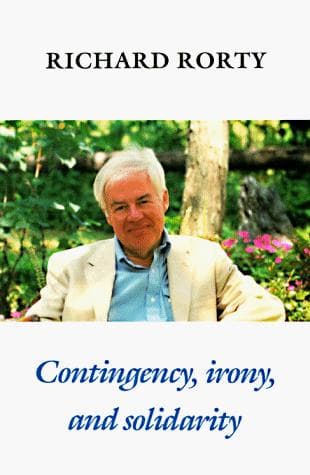
Contingency, Irony, and Solidarity
الطارئية والسخرية والتضامن
Contingence, ironie et solidarité
Editorial summary
Richard Rorty's Contingency, Irony, and Solidarity advances a thoroughgoing philosophical naturalism that dissolves traditional metaphysical questions, including those concerning God's existence. The work develops Rorty's neo-pragmatist vision through three interconnected arguments about language, selfhood, and community, each undermining the conceptual framework within which theological debates traditionally occur.
Rorty argues that language constitutes a contingent human creation rather than a medium for representing reality. This linguistic turn eliminates the possibility of discovering timeless truths about God or anything else. Philosophy cannot access a "view from nowhere" to adjudicate between theistic and atheistic worldviews. Instead, vocabularies succeed or fail based on their utility for human purposes. Religious language thus becomes one vocabulary among others, valuable insofar as it helps individuals cope with existence, but possessing no privileged epistemic status.
The concept of the "liberal ironist" emerges as Rorty's ideal figure who recognizes the contingency of her final vocabulary while remaining committed to reducing cruelty. This position precludes both dogmatic atheism and traditional theism. The ironist cannot ground ethics in divine commands or metaphysical truths but must create meaning through redescription. Rorty particularly valorizes novelists and poets who expand human sympathy through new metaphors rather than philosophers seeking foundational truths.
Drawing on Nietzsche, Freud, and Heidegger, Rorty portrays the self as a contingent web of beliefs and desires rather than a soul bearing the imago Dei. This anti-essentialist view of human nature removes the theological significance traditionally attached to personhood. Solidarity replaces universal human dignity grounded in divine creation. Rorty advocates expanding the circle of "we" through sentimental education rather than rational argument or religious revelation.
The work's significance for God debates lies in its methodological dissolution rather than direct refutation of theism. Rorty sidesteps arguments about divine existence by denying the coherence of the metaphysical framework supporting such debates. His post-philosophical culture would privatize religious belief while maintaining secular public discourse. This position challenges both natural theology and atheistic rationalism by rejecting their shared assumption that reason can arbitrate ultimate questions. Conservative critics charge Rorty with covert nihilism, while sympathetic readers appreciate his attempt to preserve religious consolation without metaphysical commitment. The work exemplifies late twentieth century anti-foundationalism's implications for theological discourse.
Argument formulations engaged
Related works
Rorty, Richard (1989). Contingency, Irony, and Solidarity. Cambridge University Press.
@book{contingency-irony-and-solidarity-1989,
  author    = {Rorty, Richard},
  title     = {Contingency, Irony, and Solidarity},
  year      = {1989},
  publisher = {Cambridge University Press},
  url       = {https://god-database.com/en/works/contingency-irony-and-solidarity-1989}
}