
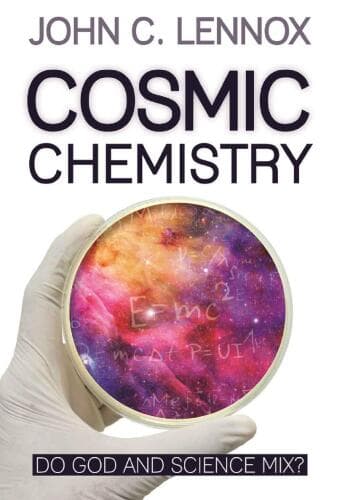
Cosmic Chemistry: Do God and Science Mix?
الكيمياء الكونية: هل يختلط الله والعلم؟
Chimie cosmique : Dieu et la science se mélangent-ils ?
Editorial summary
The contemporary dialogue between science and religion finds renewed vigor in John Lennox's examination of their compatibility. The mathematician and philosopher of science challenges the prevalent narrative that scientific advancement necessarily entails the abandonment of theistic belief. His work systematically addresses the assumption that empirical methodology and religious faith occupy mutually exclusive domains of human understanding.
Lennox structures his argument around several core contentions. First, he maintains that the historical development of modern science emerged not despite but because of theological convictions about cosmic intelligibility. The pioneers of scientific revolution, including Newton, Kepler, and Faraday, understood their investigations as uncovering divinely instituted natural laws. Second, he disputes the philosophical sufficiency of scientific materialism, arguing that science addresses mechanism while remaining silent on agency and purpose. The author distinguishes between competing worldviews that interpret scientific data rather than viewing science itself as inherently atheistic.
The work engages prominently with the New Atheist movement, particularly addressing arguments advanced by Richard Dawkins, Lawrence Krauss, and Stephen Hawking. Lennox examines their claims that scientific explanations render divine causation superfluous, offering counterarguments that question the logical foundations of such assertions. He challenges the god-of-the-gaps accusation by proposing that theism provides a more comprehensive explanatory framework for scientific intelligibility itself.
Methodologically, Lennox employs philosophical analysis alongside scientific exposition, drawing from developments in cosmology, biology, and information theory. His treatment of fine-tuning arguments, the origin of biological information, and consciousness represents an attempt to demonstrate areas where materialist explanations face significant challenges. The author's background in pure mathematics informs his discussion of abstract reasoning and its implications for naturalistic epistemology.
The monograph's significance lies in its systematic challenge to the cultural assumption of science-religion incompatibility. By examining the philosophical presuppositions underlying both scientific practice and metaphysical naturalism, Lennox contributes to ongoing debates about the proper boundaries and interpretive frameworks for scientific knowledge. His work represents a sustained argument that scientific discovery, rather than eliminating space for religious belief, may actually provide grounds for considering theistic explanations of cosmic order and biological complexity. The text serves as a comprehensive response to those who claim scientific literacy demands atheistic conclusions.
Argument formulations engaged
Related works
Lennox, John (2021). Cosmic Chemistry: Do God and Science Mix?. Lion Hudson.
@book{cosmic-chemistry-do-god-and-science-mix-,
  author    = {Lennox, John},
  title     = {Cosmic Chemistry: Do God and Science Mix?},
  year      = {2021},
  publisher = {Lion Hudson},
  url       = {https://god-database.com/en/works/cosmic-chemistry-do-god-and-science-mix-2021}
}