
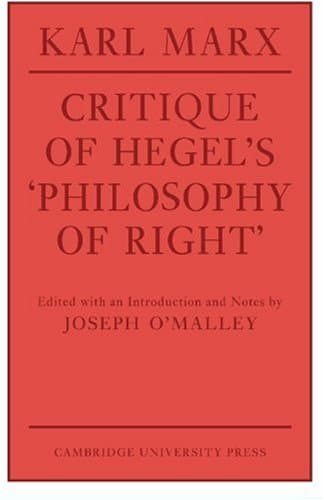
Critique of Hegel's Philosophy of Right
نقد فلسفة الحق عند هيغل
Critique de la philosophie du droit de Hegel
Editorial summary
Marx's Critique of Hegel's Philosophy of Right represents a pivotal early work that establishes his materialist approach to religious criticism while challenging Hegel's idealist framework. Written in 1843, the text examines how religious consciousness emerges from and reflects material social conditions, advancing a sociological interpretation of religious belief that profoundly influences subsequent debates about God's existence.
The work begins with Marx's famous declaration that criticism of religion forms the premise of all criticism. He argues that religion functions as both an expression of real suffering and a protest against it, famously characterizing it as "the opium of the people." This metaphor captures Marx's dual understanding: religion simultaneously soothes the pain of oppression while preventing recognition of its material causes. Unlike theological critics who debate God's attributes or existence through philosophical argumentation, Marx shifts focus to religion's social function and origin.
Marx develops his critique through systematic engagement with Hegel's political philosophy, particularly rejecting Hegel's treatment of the state as the actualization of ethical life. Where Hegel sees religion and state as complementary expressions of absolute spirit, Marx identifies them as interconnected forms of human self-alienation. He argues that Hegel's philosophical idealism mirrors and reinforces religious consciousness by inverting the relationship between thought and reality. This methodological critique establishes Marx's distinctive approach: rather than debating God's existence directly, he examines the material conditions that produce and sustain religious belief.
The text's contribution to debates about God lies in its sociological reframing of the question. Marx argues that religious criticism must transform into criticism of the social conditions that necessitate religious illusion. He contends that humans create God as a projection of their own alienated essence, but this projection stems from real material alienation in economic and political life. This analysis shifts the terrain from metaphysical speculation to social theory.
Marx's influence on subsequent religious criticism proves substantial. His materialist method inspires later sociological and anthropological approaches to religion, while his concept of ideology shapes critical analyses of religious institutions. The work establishes a tradition of examining religion not as a philosophical problem requiring resolution but as a social phenomenon demanding historical and material explanation. This reorientation continues to inform contemporary debates about secularization, religious persistence, and the relationship between economic conditions and religious belief.
Argument formulations engaged
Related works
Marx, Karl (1843). Critique of Hegel's Philosophy of Right. Cambridge University Press.
@book{critique-of-hegels-philosophy-of-right-1,
  author    = {Marx, Karl},
  title     = {Critique of Hegel's Philosophy of Right},
  year      = {1843},
  publisher = {Cambridge University Press},
  url       = {https://god-database.com/en/works/critique-of-hegels-philosophy-of-right-1843}
}