
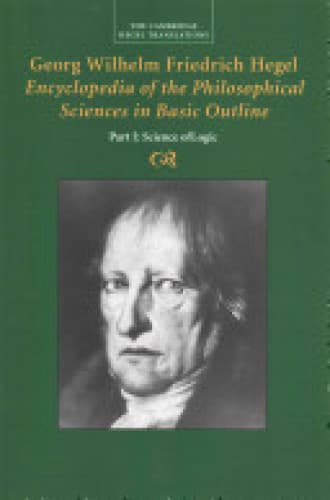
Encyclopedia of the Philosophical Sciences
موسوعة العلوم الفلسفية
Encyclopédie des sciences philosophiques
Editorial summary
This systematic philosophical work represents Hegel's mature attempt to demonstrate that absolute reality is fundamentally spiritual in nature, culminating in what he terms "absolute spirit" or God. The Encyclopedia presents philosophy as a circular science that comprehends the totality of reality through three interconnected parts: Logic (the science of the Idea in itself), Nature (the Idea in its otherness), and Spirit (the Idea returned to itself). This tripartite structure reflects Hegel's conviction that God or the Absolute undergoes a process of self-externalization and return, making divine reality accessible to philosophical comprehension.
The work advances a sophisticated philosophical theism that departs radically from traditional conceptions of God as a transcendent being separate from the world. Instead, Hegel argues that God achieves full self-consciousness only through the finite realm, particularly through human consciousness and history. The Logic section develops categories of pure thought that constitute the divine mind before creation, while the Philosophy of Nature traces how the Absolute externalizes itself in space and time. The Philosophy of Spirit culminates in absolute knowing, where finite consciousness recognizes its unity with the infinite.
Hegel's method employs dialectical reasoning to show how each category of thought necessarily passes over into its opposite and finds resolution in a higher synthesis. This approach allows him to argue against both traditional theism, which he views as maintaining an unbridgeable gulf between God and world, and atheistic materialism, which fails to account for the spiritual dimension of reality. He particularly challenges the Enlightenment's restriction of knowledge to finite understanding, exemplified by Kant's critical philosophy, which declared knowledge of God impossible.
The Encyclopedia's significance for debates about God lies in its ambitious claim that philosophy can achieve absolute knowledge of the divine through systematic reasoning. By presenting God not as an object of faith beyond reason but as the very substance of rational thought itself, Hegel attempts to overcome the modern separation between philosophy and theology. His identification of God with the self-developing system of reason provides a powerful alternative to both fideism and skepticism, though it raises questions about whether this philosophical Absolute adequately captures religious conceptions of a personal God. The work's influence extends through subsequent idealist philosophy and dialectical theology, shaping modern discussions about the relationship between immanence and transcendence.
Argument formulations engaged
Related works
Hegel, Georg Wilhelm Friedrich (1817). Encyclopedia of the Philosophical Sciences. Cambridge University Press.
@book{encyclopedia-of-the-philosophical-scienc,
  author    = {Hegel, Georg Wilhelm Friedrich},
  title     = {Encyclopedia of the Philosophical Sciences},
  year      = {1817},
  publisher = {Cambridge University Press},
  url       = {https://god-database.com/en/works/encyclopedia-of-the-philosophical-sciences-1817}
}