
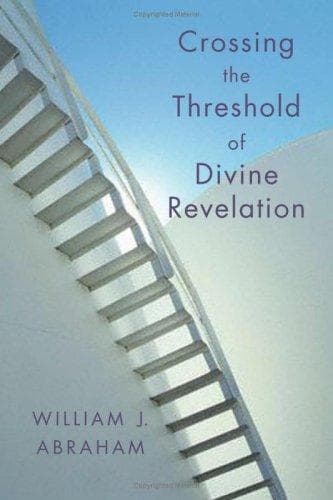
Crossing the Threshold of Divine Revelation
عبور عتبة الوحي الإلهي
Franchir le seuil de la révélation divine
Editorial summary
This monograph presents a robust epistemological defense of divine revelation as a legitimate source of knowledge, challenging the dominant naturalistic assumptions that have marginalized theological claims in contemporary philosophy. Abraham develops a sophisticated account of how divine revelation functions as a threshold concept that, once crossed, opens up new epistemic possibilities for understanding reality.
The work directly confronts the post-Enlightenment prejudice against revelation as a knowledge source, arguing that secular epistemology operates with its own unexamined presuppositions about what counts as rational belief. Abraham contends that the exclusion of divine revelation from serious epistemological consideration stems not from rigorous philosophical analysis but from metaphysical commitments that prejudge the question. He demonstrates how standard objections to revelation often assume what they need to prove, namely that naturalistic explanations exhaust the possibilities for genuine knowledge.
Central to Abraham's argument is the notion of epistemic fit between different types of reality and their appropriate means of apprehension. Just as empirical methods suit physical phenomena and mathematical reasoning suits abstract relations, he argues that divine revelation represents the fitting epistemic access to transcendent reality. The threshold metaphor captures how accepting revelation involves a fundamental shift in one's epistemic framework rather than simply adding new beliefs to an existing structure.
The monograph engages critically with both evidentialist and Reformed epistemologies, finding each insufficient for adequately accounting for revelatory knowledge. Against evidentialists, Abraham argues that demanding evidence for revelation misunderstands its nature as a unique epistemic category. Against Reformed epistemologists, he maintains that revelation requires more than properly functioning cognitive faculties, involving instead a divine initiative that transforms human knowing capacities.
Abraham's contribution lies in providing a philosophically rigorous account of revelation that neither retreats into fideism nor capitulates to secular epistemic standards. He shows how taking revelation seriously as a knowledge source need not violate intellectual integrity but rather expands our understanding of knowledge itself. The work challenges philosophers of religion to reconsider their methodological assumptions and offers theologians sophisticated tools for defending the cognitive legitimacy of their discipline. By reframing the debate around threshold concepts and epistemic fit, Abraham opens new avenues for dialogue between theological and philosophical approaches to knowledge, making this monograph essential reading for those engaged in fundamental questions about the sources and limits of human knowledge.
Argument formulations engaged
Abraham, William J. (2006). Crossing the Threshold of Divine Revelation. Eerdmans.
@book{crossing-the-threshold-of-divine-revelat,
  author    = {Abraham, William J.},
  title     = {Crossing the Threshold of Divine Revelation},
  year      = {2006},
  publisher = {Eerdmans},
  url       = {https://god-database.com/en/works/crossing-the-threshold-of-divine-revelation-2006}
}