
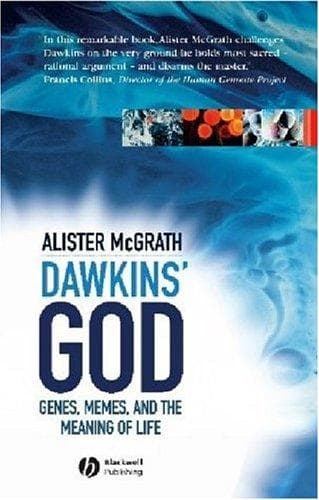
Dawkins' GOD.. Genes, Memes, and the Meaning of Life
إله دوكينز.. الجينات والميمات ومعنى الحياة
Le Dieu de Dawkins.. Gènes, mèmes et sens de la vie
Richard Dawkins' scientific arguments against religious belief rest on philosophical assumptions that exceed what biology and evolutionary theory can legitimately establish, and theism remains a rationally defensible position in dialogue with modern science.
Editorial summary
McGrath's monograph presents a systematic critique of Richard Dawkins' atheistic worldview, examining the scientific, philosophical, and theological dimensions of Dawkins' arguments against religious belief. Writing as both a theologian and scientist with doctorates in molecular biophysics and divinity, McGrath challenges Dawkins' central thesis that science necessarily leads to atheism and that religious faith represents an intellectual virus harmful to human progress.
The work engages primarily with Dawkins' gene-centered evolutionary theory and its philosophical extensions, particularly the concept of memes as units of cultural transmission. McGrath argues that Dawkins illegitimately extrapolates from legitimate scientific observations about natural selection to comprehensive metaphysical claims about reality. While acknowledging the explanatory power of neo-Darwinian theory within biology, McGrath contends that Dawkins commits a category error when moving from scientific description to philosophical prescription, particularly in dismissing design arguments and religious experience.
McGrath employs critical analysis to demonstrate internal inconsistencies in Dawkins' position. He examines how Dawkins' meme theory, which portrays religious ideas as parasitic mental viruses, lacks empirical support and fails to account for the persistence and positive social functions of religious belief. The analysis reveals how Dawkins' scientific materialism itself functions as an ideological commitment rather than a necessary conclusion from scientific evidence.
The monograph makes significant contributions to design argument debates by distinguishing between different conceptions of design and purpose in nature. McGrath argues that contemporary physics and cosmology raise legitimate questions about fine-tuning that Dawkins dismisses too readily. He develops a cumulative case approach, suggesting that while no single argument proves God's existence definitively, the convergence of multiple considerations - including cosmic fine-tuning, the comprehensibility of nature, human consciousness, and religious experience - provides reasonable grounds for theistic belief.
McGrath's work matters for contemporary God debates because it demonstrates that the conflict between science and religion is not inherent but constructed. By engaging Dawkins on scientific grounds while maintaining philosophical sophistication, McGrath shows how one can embrace evolutionary biology without accepting philosophical naturalism. The monograph exemplifies how Christian analytic philosophy can engage constructively with scientific atheism, moving beyond mere apologetics to substantive intellectual exchange about fundamental questions of meaning, purpose, and ultimate reality.
Structured analysis
Argument formulations engaged
Related works
McGrath, Alister (2004). Dawkins' GOD.. Genes, Memes, and the Meaning of Life. Wiley-Blackwell.
@book{dawkins-god-genes-memes-and-the-meaning-,
  author    = {McGrath, Alister},
  title     = {Dawkins' GOD.. Genes, Memes, and the Meaning of Life},
  year      = {2004},
  publisher = {Wiley-Blackwell},
  url       = {https://god-database.com/en/works/dawkins-god-genes-memes-and-the-meaning-of-life}
}