
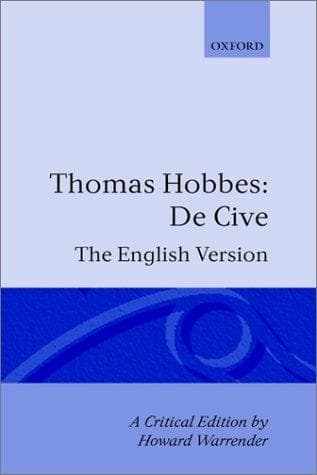
De Cive
في المواطن
Du citoyen
Editorial summary
Thomas Hobbes's "De Cive" represents a foundational work in early modern political philosophy that fundamentally reconceptualizes the relationship between divine authority, natural law, and political sovereignty. While primarily concerned with establishing the philosophical basis for absolute sovereignty, the work engages substantially with theological questions that challenge traditional Christian political thought.
Hobbes grounds his political theory in a mechanistic understanding of human nature, arguing that individuals in the state of nature exist in perpetual conflict driven by competition, diffidence, and glory. This naturalistic anthropology deliberately sidesteps theological explanations of human corruption through original sin, instead locating the source of conflict in material and psychological necessities. The work's treatment of natural law proves particularly significant for debates about God's role in moral and political order. While Hobbes formally acknowledges divine command as the ultimate source of natural law, he simultaneously argues that these laws can be discovered through reason alone, effectively secularizing their epistemic foundation.
The text's most controversial theological implications emerge from Hobbes's theory of sovereignty. By arguing that the sovereign must possess absolute authority over both civil and ecclesiastical matters, "De Cive" directly challenges the traditional separation of spiritual and temporal power that had defined Christian political thought since Augustine. Hobbes contends that religious authority must be subordinated to civil authority to prevent the conflicts that arise from divided sovereignty. This position effectively reduces religion to a matter of civil law, with the sovereign determining proper religious doctrine and practice within their territory.
Hobbes employs a distinctive methodology that combines geometric reasoning with scriptural exegesis, attempting to demonstrate that his conclusions follow necessarily from self-evident premises while remaining compatible with biblical teaching. This approach reflects the work's dual audience: secular philosophers impressed by scientific method and religious authorities concerned with scriptural warrant. The tension between these methodological commitments reveals itself in Hobbes's treatment of miracles, prophecy, and revelation, which he subjects to rational critique while maintaining their formal possibility.
"De Cive" matters to the God debate because it inaugurates a tradition of political philosophy that treats religious belief primarily as a social phenomenon requiring political management rather than as a source of transcendent truth. While Hobbes never explicitly denies God's existence, his thoroughgoing naturalism and subordination of religious to political authority effectively brackets theological claims from political reasoning, establishing a template for secular political theory that would profoundly influence subsequent Enlightenment thought.
Argument formulations engaged
Related works
Hobbes, Thomas (1642). De Cive. Oxford University Press.
@book{de-cive-1642,
  author    = {Hobbes, Thomas},
  title     = {De Cive},
  year      = {1642},
  publisher = {Oxford University Press},
  url       = {https://god-database.com/en/works/de-cive-1642}
}