
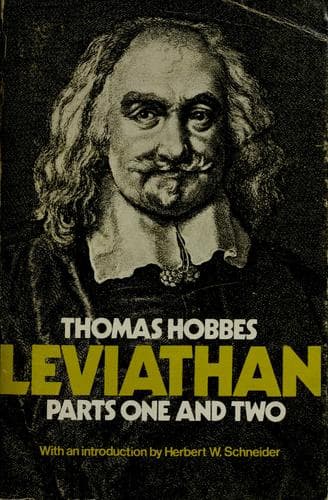
Leviathan
ليفياثان
Léviathan
Editorial summary
Thomas Hobbes's Leviathan presents a materialist philosophy that systematically excludes divine authority from political life while maintaining a complex relationship with theological questions. Though ostensibly preserving space for God, Hobbes constructs a political theory that functionally operates without divine intervention, establishing him as a pivotal figure in the secularization of political philosophy.
Hobbes grounds his argument in a mechanistic view of nature where all phenomena, including human behavior, result from matter in motion. This materialist framework extends even to seemingly spiritual experiences - apparitions become tricks of perception, and religious visions reduce to physiological disturbances. While Hobbes acknowledges God as the first cause who sets matter in motion, divine involvement effectively ends there. God becomes philosophically necessary but politically irrelevant.
The work's most radical theological move concerns revelation and religious authority. Hobbes argues that no individual can claim direct divine communication that binds others, since private revelation remains inherently unverifiable. Genuine political authority derives not from divine right but from the social contract, where individuals surrender natural rights to an absolute sovereign to escape the state of nature's perpetual warfare. The sovereign alone determines public religious doctrine, subordinating ecclesiastical to civil power.
This position challenged both traditional Christian political theology and contemporary religious conflicts. Against divine right theorists, Hobbes denies that political authority descends from God through religious institutions. Against enthusiasts claiming private revelation, he restricts valid religious knowledge to what the sovereign publicly authorizes. The Leviathan thus reads scripture through a thoroughly political lens, reinterpreting biblical narratives to support civil supremacy over religious claims.
Hobbes's methodology combines geometric reasoning with scriptural exegesis, attempting to build politics on scientific foundations while neutralizing religious opposition through biblical interpretation. This dual approach reflects the work's historical context amid England's civil wars, where competing religious factions threatened political stability. By subordinating religion to politics, Hobbes offers a solution to sectarian conflict that anticipates later secular political theory.
The Leviathan's significance for debates about God lies in its functional atheism despite formal theistic commitments. While never explicitly denying God's existence, Hobbes constructs a political order requiring no active divine participation, where religious truth becomes a matter of civil determination rather than divine revelation. This represents a crucial step toward modern secularism's separation of political authority from theological justification.
Argument formulations engaged
Related works
Hobbes, Thomas (1651). Leviathan.
@book{leviathan-1651,
  author    = {Hobbes, Thomas},
  title     = {Leviathan},
  year      = {1651},
  url       = {https://god-database.com/en/works/leviathan-1651}
}