
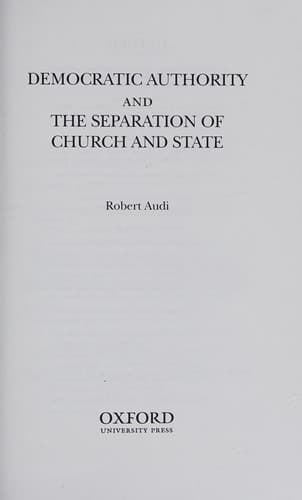
Democratic Authority and the Separation of Church and State
السلطة الديمقراطية وفصل الكنيسة عن الدولة
Autorité démocratique et séparation de l'Église et de l'État
Editorial summary
This monograph develops a comprehensive philosophical framework for understanding the proper relationship between religion and democratic governance. Audi advances a theory of democratic authority that supports institutional separation of church and state while permitting religious participation in public discourse, provided such participation meets specific normative criteria.
The work's central contribution lies in articulating principles that balance religious freedom with democratic legitimacy. Audi argues that democratic authority requires a form of public reason accessible to all citizens regardless of their religious commitments. This position challenges both strict secularists who would exclude religious voices entirely from public debate and religious traditionalists who reject constraints on faith-based political advocacy.
Audi develops several key principles governing religious participation in democracy. His "principle of secular rationale" holds that citizens should offer reasons for coercive laws that can be evaluated independently of religious premises. The "principle of secular motivation" requires that citizens be sufficiently motivated by secular reasons when advocating for restrictive policies. These principles aim to preserve democratic inclusivity while respecting religious conviction.
The analysis engages critically with prominent theorists including John Rawls, whose conception of public reason Audi finds overly restrictive, and Nicholas Wolterstorff, whose more permissive approach to religious political discourse Audi considers inadequate for protecting democratic values. Against Rawls, Audi argues that religious citizens need not bracket their comprehensive doctrines entirely. Against Wolterstorff, he maintains that unconstrained religious advocacy threatens the mutual respect essential to democratic citizenship.
Methodologically, the work employs analytical philosophy's tools of conceptual clarification and systematic argumentation. Audi carefully distinguishes between institutional separation, which he endorses, and the exclusion of religious perspectives from public debate, which he rejects. His approach seeks middle ground between rigid secularism and theocratic impulses.
The monograph's significance extends beyond academic philosophy to practical questions of religious liberty, political legitimacy, and social pluralism. In an era of increasing religious diversity and polarization, Audi's framework offers resources for negotiating conflicts between religious conviction and democratic governance. His nuanced position recognizes both the legitimate role of religious citizens in democratic societies and the need for shared standards of public justification. The work thus contributes to ongoing debates about secularization, political theology, and the foundations of liberal democracy.
Argument formulations engaged
Related works
Audi, Robert (2011). Democratic Authority and the Separation of Church and State. Oxford University Press.
@book{democratic-authority-and-the-separation-,
  author    = {Audi, Robert},
  title     = {Democratic Authority and the Separation of Church and State},
  year      = {2011},
  publisher = {Oxford University Press},
  url       = {https://god-database.com/en/works/democratic-authority-and-the-separation-of-church-and-state-2011}
}