
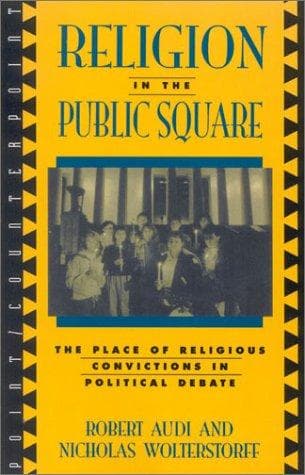
Religion in the Public Square: The Place of Religious Convictions in Political Debate
الدين في الساحة العامة: مكان القناعات الدينية في النقاش السياسي
Religion sur la place publique : La place des convictions religieuses dans le débat politique
Editorial summary
This work examines the proper role of religious convictions in liberal democratic political discourse, arguing for a principled separation between religious belief and public political argumentation. Audi develops a sophisticated framework for understanding how citizens with religious commitments can participate in democratic deliberation while respecting the pluralistic nature of modern societies.
The monograph advances two primary principles governing religious participation in politics. The principle of secular rationale requires that citizens advocating for laws or policies possess adequate secular reasons for their positions, not merely religious ones. The principle of secular motivation demands that citizens be sufficiently motivated by these secular reasons, not driven exclusively by religious convictions. Audi argues these principles protect democratic legitimacy while preserving religious freedom.
Central to Audi's analysis is the distinction between holding religious beliefs privately and deploying them in public political forums. He contends that while religious citizens need not abandon their convictions, they should exercise epistemic restraint when engaging in political advocacy that affects all citizens. This position challenges both strong secularists who would exclude religious voices entirely and religious advocates who see no distinction between private faith and public reason.
The work engages critically with liberal political theorists like John Rawls while also addressing religious critics who view such restrictions as discriminatory. Audi refines Rawlsian public reason by allowing religious arguments in public discourse provided they accompany sufficient secular justification. This middle position attempts to honor both democratic principles and religious integrity.
Audi's framework has significant implications for understanding divine authority in political contexts. By requiring secular rationale for coercive laws, he effectively limits the direct political application of perceived divine commands or religious doctrines. This approach treats religious and secular comprehensive doctrines symmetrically, requiring all citizens to translate their deepest convictions into publicly accessible reasons.
The monograph's lasting contribution lies in its careful delineation of how religious citizens can maintain personal faith while participating in pluralistic democracy. Audi demonstrates that taking religion seriously need not mean accepting its unrestricted use in political justification. His work remains influential in debates about secularism, providing a nuanced alternative to both theocratic and strictly secular visions of democratic participation.
Argument formulations engaged
Related works
Audi, Robert (1997). Religion in the Public Square: The Place of Religious Convictions in Political Debate. Rowman & Littlefield.
@book{religion-in-the-public-square-the-place-,
  author    = {Audi, Robert},
  title     = {Religion in the Public Square: The Place of Religious Convictions in Political Debate},
  year      = {1997},
  publisher = {Rowman & Littlefield},
  url       = {https://god-database.com/en/works/religion-in-the-public-square-the-place-of-religious-convictions-in-political-debate-1997}
}