
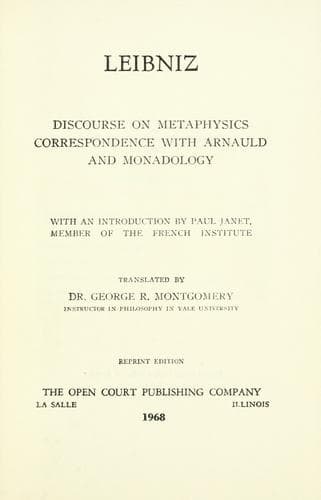
Discourse on Metaphysics
خطاب في الميتافيزيقا
Discours de métaphysique
God, as the supremely perfect being, necessarily exists and created the best of all possible worlds, grounding all substance, causality, and harmony in a rational metaphysical system.
Editorial summary
Leibniz's Discourse on Metaphysics presents a systematic rationalist defense of theism through a comprehensive metaphysical framework that seeks to demonstrate God's existence, nature, and relationship to creation. Written in 1686, this work represents a crucial intervention in early modern debates about divine providence, natural philosophy, and the rational foundations of religious belief.
The text advances a distinctive form of the cosmological argument through Leibniz's principle of sufficient reason, which holds that nothing exists or occurs without a complete explanation. Leibniz argues that the contingent nature of the world requires an explanation that cannot be found within the series of contingent things themselves. This reasoning leads necessarily to a necessary being—God—who contains within himself the reason for his own existence and serves as the ultimate ground of all contingent reality.
Leibniz also deploys a refined version of the ontological argument, building on but modifying Cartesian precedents. He contends that the concept of God as the most perfect being necessarily includes existence, since existence constitutes a perfection. However, Leibniz adds a crucial qualification absent in Descartes: one must first demonstrate that the concept of a supremely perfect being is logically possible and contains no contradiction.
The work's most innovative contribution lies in its integration of these traditional arguments within Leibniz's broader metaphysical system, particularly his doctrine of pre-established harmony and his theory of individual substances. God emerges not merely as first cause but as the supreme monad who continuously maintains all created substances in existence and ensures their harmonious interaction without direct causal influence between them.
Against both mechanistic materialists and occasionalists like Malebranche, Leibniz argues for a God who creates the best possible world through rational choice while respecting the genuine causal powers of created substances. This position attempts to preserve both divine sovereignty and creaturely autonomy, addressing contemporary anxieties about determinism and freedom.
The Discourse thus exemplifies rationalist natural theology at its most ambitious, demonstrating how metaphysical reasoning can establish not only God's existence but also specific divine attributes including wisdom, goodness, and providential care. Its influence extends through German idealism and continues to shape contemporary discussions of modal arguments for God's existence.
Argument formulations engaged
Related works
Leibniz, G. W. Discourse on Metaphysics. Anchor.
@book{discourse-on-metaphysics,
  author    = {Leibniz, G. W.},
  title     = {Discourse on Metaphysics},
  year      = {n.d.},
  publisher = {Anchor},
  url       = {https://god-database.com/en/works/discourse-on-metaphysics}
}