
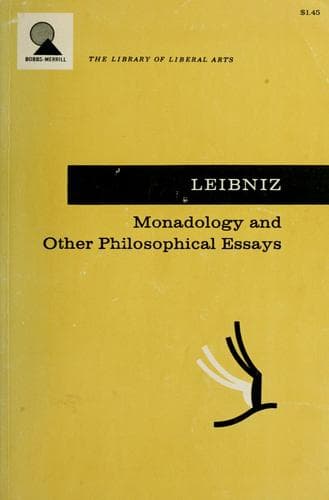
Monadology
المونادولوجيا
Monadologie
Editorial summary
Leibniz's Monadology presents a metaphysical system that grounds reality in simple, indivisible substances called monads, ultimately requiring God as the necessary being who creates and harmonizes all existence. This late work synthesizes Leibniz's mature philosophical theology, offering a rationalist demonstration of God's existence through the principle of sufficient reason and the concept of pre-established harmony.
The text argues that the universe consists of infinitely many monads, each a unique, windowless substance that mirrors the entire cosmos from its perspective. Since these monads cannot interact causally, their apparent coordination demands explanation. Leibniz locates this explanation in God, the supreme monad who pre-establishes the harmony among all created monads. Through this framework, he addresses the problem of interaction between substances that plagued Cartesian dualism while simultaneously providing a novel proof for God's existence.
Leibniz develops his theological argument through several interconnected principles. The principle of sufficient reason dictates that nothing exists without a reason for its existence. Applied to the contingent world of monads, this principle necessitates a necessary being whose essence involves existence. The principle of the best further characterizes this necessary being as perfectly good, choosing to create the best of all possible worlds. This optimistic theodicy addresses the problem of evil by arguing that apparent imperfections contribute to the greatest overall perfection.
The work engages critically with both mechanistic materialism and occasionalism. Against materialists who would reduce reality to extended matter in motion, Leibniz insists that force and perception require immaterial substances. Against occasionalists like Malebranche who make God the sole true cause, Leibniz preserves genuine creaturely activity while maintaining divine sovereignty through pre-established harmony. His system thus stakes out a middle position that affirms both divine transcendence and immanence.
The Monadology's significance for discussions of God lies in its systematic integration of metaphysics and theology. By making God structurally necessary for the coherence of any possible world, Leibniz offers a purely rational foundation for theism that bypasses appeals to revelation or religious experience. His vision of God as the monad of monads who contains all perfections virtually and creates through a kind of emanation influenced subsequent German idealism, particularly Hegel's absolute idealism. The work remains a paradigmatic example of rationalist natural theology, demonstrating how metaphysical analysis can yield robust theological conclusions.
Argument formulations engaged
Related works
Leibniz, G. W. (1714). Monadology.
@book{monadology-1714,
  author    = {Leibniz, G. W.},
  title     = {Monadology},
  year      = {1714},
  url       = {https://god-database.com/en/works/monadology-1714}
}