
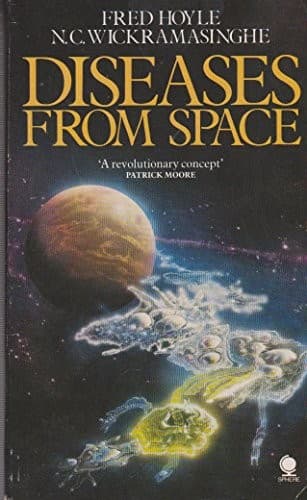
Diseases from Space
أمراض من الفضاء
Maladies de l'espace
Editorial summary
This provocative monograph advances the radical hypothesis that many terrestrial diseases originate from extraterrestrial sources, challenging conventional epidemiological models and raising unexpected questions about divine design in creation. Wickramasinghe, an astronomer and mathematician, extends the panspermia hypothesis beyond the origin of life itself to argue that viruses and bacteria continue to arrive on Earth from space, causing epidemic outbreaks throughout human history.
The work synthesizes astronomical observations, epidemiological data, and historical records to build its case. Wickramasinghe examines the seemingly random geographical distribution and timing of disease outbreaks, arguing that terrestrial explanations fail to account for certain patterns. He proposes that cometary dust and meteoritic material carry microorganisms that survive atmospheric entry and initiate epidemics upon reaching Earth's surface. The author draws on spectroscopic evidence suggesting organic compounds in interstellar clouds and analyzes historical plague patterns that appear to correlate with celestial events.
While primarily scientific in approach, the work carries significant theological implications that Wickramasinghe occasionally acknowledges. If diseases arrive from space rather than evolving solely on Earth, traditional theodicy faces new challenges. The problem of natural evil extends beyond terrestrial boundaries, suggesting either a cosmos inherently hostile to human flourishing or divine providence operating on an interplanetary scale. The hypothesis disrupts both mechanistic atheism, which assumes purely terrestrial evolutionary processes, and conventional theism, which must account for extraterrestrial suffering entering creation.
The monograph's methodology combines empirical astronomy with speculative theorizing, drawing criticism from both epidemiologists and philosophers. Critics argue that Wickramasinghe overinterprets limited spectroscopic data and ignores well-established mechanisms of disease transmission. However, the work's significance lies less in its scientific validity than in its expansion of the conceptual space for discussing natural evil and divine action. By proposing that pathogens rain from the heavens, Wickramasinghe inadvertently revives ancient notions of celestial influence on human affairs while challenging both naturalistic and providential accounts of disease.
The text represents an unusual intervention in science-religion dialogue, neither explicitly theistic nor atheistic, but raising profound questions about cosmic purpose and the scope of divine sovereignty. Its lasting contribution may be forcing both theologians and scientists to consider whether their Earth-bound perspectives adequately address the reality of suffering in a vast, interconnected universe.
Argument formulations engaged
Chandra, Wickramasinghe (1979). Diseases from Space.
@book{diseases-from-space-1979,
  author    = {Chandra, Wickramasinghe},
  title     = {Diseases from Space},
  year      = {1979},
  url       = {https://god-database.com/en/works/diseases-from-space-1979}
}