
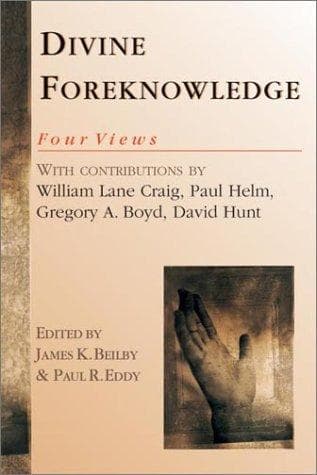
Divine Foreknowledge: Four Views
المعرفة الإلهية المسبقة: أربع وجهات نظر
Prescience divine : Quatre points de vue
Editorial summary
This volume assembles four contemporary philosophical perspectives on divine foreknowledge, addressing one of theology's most enduring puzzles: how God's omniscience relates to human freedom, divine providence, and temporal existence. The collection exemplifies the sophisticated analytic approach that characterizes late twentieth-century philosophy of religion, presenting competing solutions to the apparent tension between God's complete knowledge of future events and genuine human agency.
The volume features four distinct positions, each defended by a leading proponent. The open theist view denies that God possesses exhaustive foreknowledge of future free actions, arguing that such knowledge is logically impossible even for an omniscient being. This perspective maintains that God knows all that can be known, but future free choices remain genuinely open and thus unknowable. The simple foreknowledge position affirms God's complete knowledge of the future while denying that this knowledge can be providentially useful, since what God knows will happen must happen. The Ockhamist approach, drawing on William of Ockham's medieval insights, contends that God's eternal knowledge of temporal events does not compromise human freedom because divine knowledge does not causally determine human choices. The Molinist view, based on Luis de Molina's doctrine of middle knowledge, proposes that God knows not only what will happen but also what would happen in any possible circumstance, enabling providential governance without eliminating freedom.
Each contributor presents their position through rigorous argumentation, engaging directly with the logical, metaphysical, and theological implications of their view. The format encourages philosophical dialogue, as each author responds to the others' positions, exposing points of convergence and fundamental disagreements. This structure illuminates how different starting assumptions about time, causation, and the divine nature lead to divergent conclusions about foreknowledge.
The work's significance extends beyond technical philosophy of religion to impact systematic theology, biblical interpretation, and practical religious life. Questions about prayer, providence, prophecy, and human responsibility all intersect with these competing accounts of divine foreknowledge. By bringing analytical precision to bear on classical theological problems, the volume demonstrates philosophy's continued relevance to understanding divine attributes. The debate reveals how philosophical theology remains methodologically divided even among thinkers who share theistic commitments, suggesting that rational reflection alone cannot definitively resolve certain fundamental questions about God's relationship to time and human action.
Argument formulations engaged
Related works
Flint, Thomas P. (2001). Divine Foreknowledge: Four Views.
@book{divine-foreknowledge-four-views-2001,
  author    = {Flint, Thomas P.},
  title     = {Divine Foreknowledge: Four Views},
  year      = {2001},
  url       = {https://god-database.com/en/works/divine-foreknowledge-four-views-2001}
}