
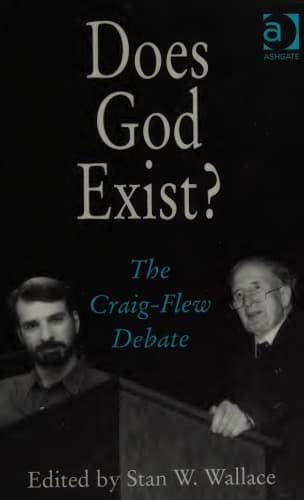
Does God Exist? The Craig-Flew Debate
هل يوجد الله؟ النقاش بين كريغ وفلو
Dieu existe-t-il ? Le débat Craig-Flew
The debate between William Lane Craig and Antony Flew stages a direct confrontation between classical natural theology and atheistic naturalism over whether sufficient rational grounds exist for belief in God's existence.
Editorial summary
This volume presents the 1998 debate between William Lane Craig and Antony Flew at the University of Wisconsin, capturing a pivotal moment in contemporary philosophical theology. The work exemplifies the formal debate format as a method for advancing philosophical discourse about God's existence, featuring two prominent figures who represent opposing traditions in natural theology and atheological philosophy.
Craig advances a cumulative case for theism through multiple argument families. His cosmological argument employs the kalam formulation, arguing that the universe's beginning requires a transcendent cause. He supplements this with a teleological argument emphasizing cosmic fine-tuning, contending that the universe's life-permitting constants suggest intelligent design. Craig's moral argument claims that objective moral values and duties require a divine foundation. Throughout, he employs modal logic and probability theory to structure his arguments, demonstrating how contemporary analytic philosophy can serve traditional theistic ends.
Flew, representing philosophical atheism, challenges each component of Craig's case while advancing the presumption of atheism - the methodological principle that theism bears the burden of proof. He contests the cosmological argument by questioning whether the universe requires a cause and challenges the inference from causation to personal agency. Against the design argument, Flew invokes naturalistic explanations and questions whether apparent design necessitates a designer. He particularly emphasizes the problem of evil as a counterargument, maintaining that suffering's extent and distribution remain incompatible with classical theism.
The debate's significance extends beyond its specific arguments to its methodological contributions. It demonstrates how formal debate structures can clarify philosophical positions, expose hidden premises, and advance dialectical progress. The format requires each participant to engage directly with objections, preventing the parallel monologues that sometimes characterize academic exchange. The volume includes audience questions and responses, showing how philosophical arguments about God function in public intellectual discourse.
This work matters for several reasons. First, it captures Flew's position shortly before his later conversion to deism, providing historical documentation of his atheistic phase. Second, it showcases how traditional theological arguments adapt to contemporary philosophical standards. Third, it illustrates the vitality of natural theology debates in the late twentieth century, countering narratives about secularization's inevitability. The debate format itself suggests that questions about God remain philosophically productive rather than merely historical curiosities.
Argument formulations engaged
Related works
Craig, William Lane Does God Exist? The Craig-Flew Debate.
@book{does-god-exist-the-craig-flew-debate,
  author    = {Craig, William Lane},
  title     = {Does God Exist? The Craig-Flew Debate},
  year      = {n.d.},
  url       = {https://god-database.com/en/works/does-god-exist-the-craig-flew-debate}
}