
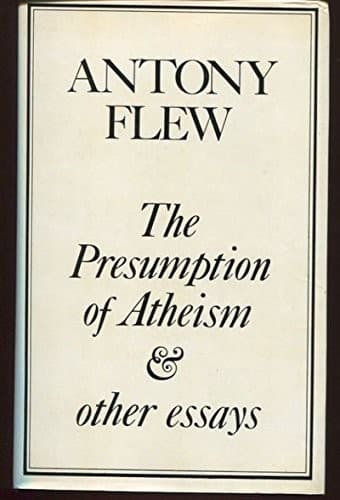
The Presumption of Atheism
افتراض الإلحاد
La présomption d'athéisme
In the absence of compelling positive evidence for God's existence, atheism — understood as the mere absence of theistic belief — should be the rational default position, placing the burden of proof squarely on the theist.
Editorial summary
This seminal work reframes the fundamental dialectical structure of debates about God's existence by arguing that atheism, properly understood as the absence of belief rather than positive denial, should serve as the default epistemic position. Flew contends that the burden of proof rests entirely on those who assert God's existence, not on those who remain unconvinced by theistic arguments.
The work's central innovation lies in distinguishing between positive atheism (the claim that God does not exist) and negative atheism (the mere absence of belief in God). Flew advocates for the latter as the presumptive starting point in rational inquiry about divine existence. This methodological atheism parallels the presumption of innocence in legal contexts: just as defendants need not prove their innocence, non-believers need not prove God's non-existence. Rather, theists must provide sufficient evidence to overcome the initial presumption against their claim.
Flew's analytical approach systematically examines how burden of proof operates in rational discourse. He argues that extraordinary claims require extraordinary evidence, and since God's existence represents a metaphysically extraordinary claim, it demands correspondingly robust justification. The work critiques various attempts to shift this burden onto atheists, demonstrating why such moves fail according to standard principles of rational inquiry.
The text engages critically with traditional natural theology, particularly cosmological and teleological arguments, showing how they fail to meet the evidential threshold required to overcome the presumption of atheism. Flew also addresses the common theistic rejoinder that atheism itself constitutes a positive claim requiring justification, carefully explaining why this misunderstands the logical structure of belief and non-belief.
The work's influence extends beyond philosophy of religion into broader epistemological discussions about default positions, evidential standards, and the allocation of justificatory responsibilities in rational debate. Flew's framework has become standard in contemporary analytical philosophy of religion, fundamentally shaping how philosophers approach questions of proof and presumption regarding religious claims.
While maintaining philosophical rigor, Flew avoids dogmatic atheism, acknowledging that sufficient evidence could in principle overcome the presumption. This stance reflects the work's fundamentally methodological rather than metaphysical focus, establishing procedural rules for inquiry rather than predetermined conclusions about ultimate reality.
Argument formulations engaged
Related works
Flew, Antony The Presumption of Atheism.
@book{the-presumption-of-atheism,
  author    = {Flew, Antony},
  title     = {The Presumption of Atheism},
  year      = {n.d.},
  url       = {https://god-database.com/en/works/the-presumption-of-atheism}
}