
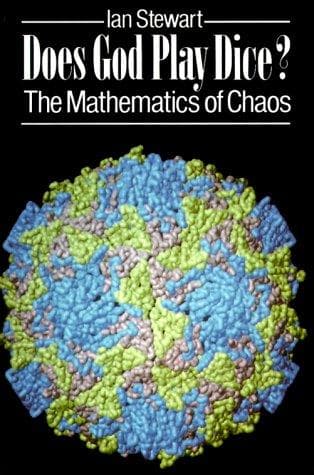
Does God Play Dice? The New Mathematics of Chaos
هل يلعب الله بالنرد؟ الرياضيات الجديدة للفوضى
Dieu joue-t-il aux dés ? Les nouvelles mathématiques du chaos
Editorial summary
This work examines the philosophical implications of chaos theory for traditional conceptions of determinism and divine providence. Stewart, a mathematician at the University of Warwick, explores how the discovery of chaotic dynamics in deterministic systems challenges both scientific materialism and classical theistic notions of divine control over nature.
The monograph traces the historical development of deterministic science from Newton through Laplace, showing how the clockwork universe model supported both atheistic mechanism and certain forms of theological determinism. Stewart demonstrates that chaos theory fundamentally disrupts this framework by revealing that deterministic equations can produce behavior so sensitive to initial conditions that long-term prediction becomes impossible. This mathematical fact, he argues, reopens questions about causation, free will, and divine action that seemed settled by Newtonian physics.
Stewart engages critically with both reductionist scientists who see chaos as merely epistemic uncertainty and theologians who interpret it as evidence for divine intervention. Against the former, he maintains that chaos represents genuine ontological indeterminacy within deterministic systems. Against the latter, he argues that chaos does not create "gaps" for supernatural action but rather reveals the intrinsic creativity of natural processes. The work particularly challenges process theologians like John Polkinghorne who invoke chaos theory to defend divine action in nature.
The author's method combines mathematical exposition with philosophical analysis, making technical concepts accessible while avoiding oversimplification. Stewart draws on examples from meteorology, ecology, and cosmology to illustrate how chaotic dynamics pervade nature at multiple scales. His treatment of the butterfly effect and strange attractors illuminates how order and randomness interweave in natural systems.
The monograph's significance lies in its balanced treatment of chaos theory's theological implications. Stewart avoids both the nihilistic conclusion that chaos eliminates meaning from nature and the apologetic claim that it proves divine design. Instead, he suggests that chaos theory demands new metaphysical categories beyond simple determinism or indeterminism. This contribution matters for contemporary discussions of emergence, complexity, and divine action, offering a mathematically informed perspective that challenges simplistic appropriations of chaos theory in theology. The work remains influential in science-religion dialogue, particularly regarding questions of providence, natural evil, and the openness of the future.
Argument formulations engaged
Related works
Stewart, Ian (1989). Does God Play Dice? The New Mathematics of Chaos. Blackwell.
@book{does-god-play-dice-the-new-mathematics-o,
  author    = {Stewart, Ian},
  title     = {Does God Play Dice? The New Mathematics of Chaos},
  year      = {1989},
  publisher = {Blackwell},
  url       = {https://god-database.com/en/works/does-god-play-dice-the-new-mathematics-of-chaos-1989}
}