
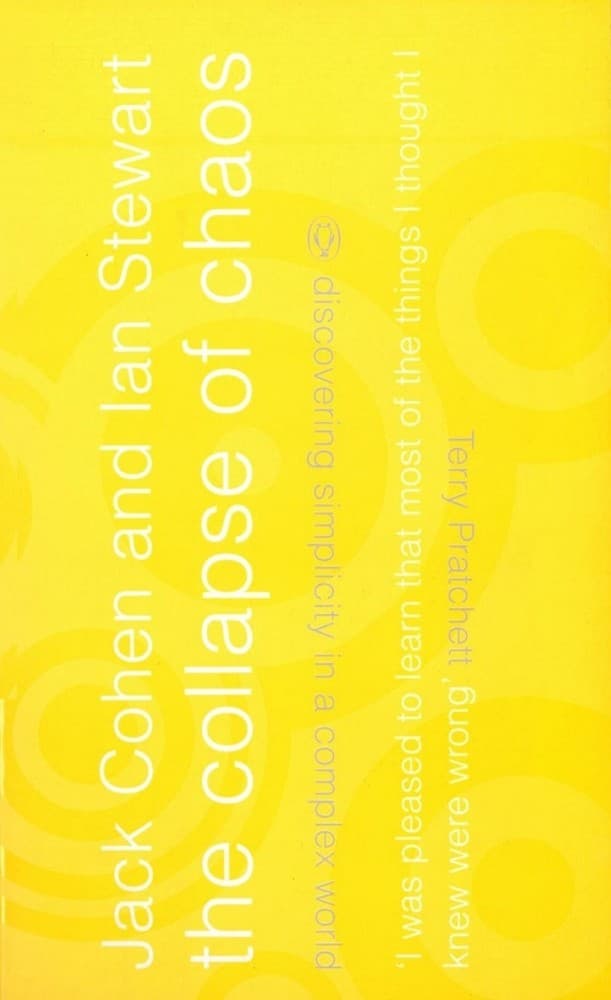
The Collapse of Chaos: Discovering Simplicity in a Complex World
انهيار الفوضى: اكتشاف البساطة في عالم معقد
L'Effondrement du chaos : Découvrir la simplicité dans un monde complexe
Editorial summary
Stewart's The Collapse of Chaos presents a distinctive approach to understanding natural complexity that bears significant implications for theological discourse, particularly regarding design arguments and divine action. The work challenges both reductionist scientific paradigms and traditional teleological reasoning by proposing that the emergence of simplicity from chaos represents a fundamental feature of reality requiring neither deterministic laws nor external design.
The text develops a sophisticated framework for comprehending how complex systems generate ordered patterns through self-organization rather than top-down control. Stewart demonstrates that phenomena traditionally cited as evidence of divine design—from biological structures to cosmic organization—emerge naturally from the interplay between chaos and order. This analysis directly confronts both mechanistic worldviews that eliminate mystery and theological positions that locate divine action in gaps within scientific explanation.
Stewart's methodology combines mathematical analysis with philosophical reflection, examining how feedback loops, phase transitions, and emergent properties create higher-level simplicities from lower-level complexities. The work engages critically with both scientific reductionism and intelligent design theory, arguing that each misunderstands the relationship between simplicity and complexity. Rather than viewing order as imposed externally or reducible to fundamental particles, Stewart presents it as an intrinsic feature of dynamic systems.
The theological implications prove substantial. By demonstrating that complexity generates its own organizing principles, the work undermines design arguments that infer divine intention from natural order. Simultaneously, it challenges atheistic positions that rely on reductionist materialism, suggesting that reality possesses creative capacities exceeding mechanistic description. Stewart's framework implies that traditional debates about divine action may rest on false dichotomies between natural law and supernatural intervention.
Within contemporary philosophy of religion, this work contributes to discussions about emergence, naturalism, and divine action. Stewart's insights resonate with process theology and emergentist philosophies while challenging both classical theism and scientific materialism. The text suggests that understanding reality requires transcending the opposition between mechanical causation and purposive design, opening space for reconceptualizing the relationship between natural processes and ultimate questions. Though not explicitly theological, the work's implications for how complexity relates to simplicity, order to chaos, and emergence to reduction make it essential reading for those engaging questions about cosmic purpose, natural theology, and the interface between scientific and religious explanation.
Argument formulations engaged
Related works
Stewart, Ian (1994). The Collapse of Chaos: Discovering Simplicity in a Complex World. Viking.
@book{the-collapse-of-chaos-discovering-simpli,
  author    = {Stewart, Ian},
  title     = {The Collapse of Chaos: Discovering Simplicity in a Complex World},
  year      = {1994},
  publisher = {Viking},
  url       = {https://god-database.com/en/works/the-collapse-of-chaos-discovering-simplicity-in-a-complex-world-1994}
}