
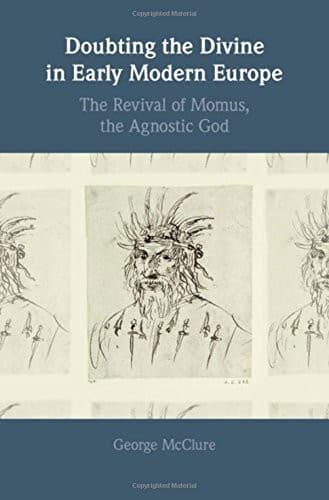
Doubting the Divine in Early Modern Europe: The Revival of Momus, the Agnostic God
التشكيك في الإلهي في أوروبا الحديثة المبكرة: إحياء موموس، الإله اللاأدري
Douter du divin dans l'Europe moderne naissante : le renouveau de Momus, le dieu agnostique
Early modern Europe witnessed a significant revival of the figure of Momus — the classical god of mockery and doubt — as a vehicle for articulating agnostic, skeptical, and critical attitudes toward divine providence, religious certainty, and the nature of God.
Editorial summary
McClure's monograph traces the remarkable renaissance of Momus, the ancient Greek god of criticism and fault-finding, as a literary device in early modern European thought. The study demonstrates how this obscure deity became an unexpected vehicle for articulating religious skepticism and epistemological doubt during a period of intense theological conflict. Through careful analysis of texts spanning from the fifteenth to seventeenth centuries, McClure reveals how writers employed Momus to voice critiques of divine providence and human certainty that would have been dangerous to express directly.
The work's central contribution lies in uncovering a neglected tradition of agnostic expression within ostensibly Christian literary culture. McClure argues that the revival of Momus provided intellectuals with a classical precedent for questioning divine perfection and cosmic order without explicitly denying God's existence. By examining works by Alberti, Erasmus, Bruno, and others, the study shows how Momus functioned as a "safe" persona through which authors could explore radical doubts about divine benevolence, the problem of evil, and humanity's capacity to comprehend the divine. This literary strategy allowed writers to navigate between orthodox belief and outright atheism, creating what McClure identifies as a distinctly agnostic discourse.
Methodologically, McClure employs intellectual history to contextualize these Momus texts within broader currents of Renaissance humanism, Reformation theology, and emerging scientific rationalism. The analysis connects the Momus tradition to contemporary debates about divine hiddenness, the limits of natural theology, and the reliability of revelation. Particularly significant is McClure's demonstration that this agnostic strand existed alongside and often within explicitly Christian writings, suggesting that religious doubt was more pervasive and sophisticated than traditionally acknowledged.
The monograph challenges conventional narratives about the secular emergence in early modernity by revealing how classical mythology provided resources for religious skepticism centuries before the Enlightenment. McClure's work illuminates an important but overlooked chapter in the history of agnosticism, showing how early modern thinkers used literary indirection to explore fundamental uncertainties about divine nature and human knowledge. This recovery of the Momus tradition enriches understanding of how religious doubt found expression within the constraints of Christian culture, offering new perspectives on the intellectual genealogy of modern agnosticism.
Structured analysis
Argument formulations engaged
McClure, George Doubting the Divine in Early Modern Europe: The Revival of Momus, the Agnostic God. University of Chicago Press.
@book{doubting-the-divine-in-early-modern-euro,
  author    = {McClure, George},
  title     = {Doubting the Divine in Early Modern Europe: The Revival of Momus, the Agnostic God},
  year      = {n.d.},
  publisher = {University of Chicago Press},
  url       = {https://god-database.com/en/works/doubting-the-divine-in-early-modern-europe-the-revival-of-momus-the-agnostic-god}
}