
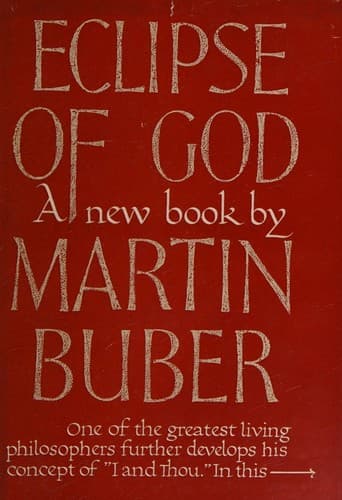
Eclipse of God
كسوف الله
Éclipse de Dieu
Editorial summary
This monograph represents Buber's profound meditation on the modern crisis of divine absence, extending his dialogical philosophy into a diagnosis of contemporary spiritual malaise. The work examines what Buber terms the "eclipse of God" - not God's death or disappearance, but rather humanity's self-imposed inability to encounter the divine through authentic relation. Building upon his earlier distinction between I-Thou and I-It relationships, Buber argues that modern civilization has progressively obscured access to the eternal Thou through excessive objectification and instrumentalization of existence.
The text engages critically with both religious orthodoxy and secular philosophy, rejecting traditional metaphysical proofs while equally dismissing atheistic reductionism. Buber contends that Nietzsche's proclamation of God's death mistakenly confuses a human perceptual crisis for an ontological event. The eclipse metaphor proves central: just as the sun remains present during an eclipse despite being obscured, so too does the divine persist despite humanity's inability to perceive it. This obscuration results from what Buber identifies as the modern tendency to transform all encounters into subject-object relations, thereby closing off the possibility of genuine meeting with the absolute.
Against existentialist philosophers like Sartre and Heidegger, Buber maintains that authentic existence requires not radical autonomy but openness to relation with the eternal Thou. He traces this eclipse through analyses of modern philosophy, psychology, and literature, demonstrating how each domain reflects and reinforces the loss of immediate divine encounter. The work particularly critiques Jung's psychological interpretation of religion, arguing that reducing God to psychic contents represents another form of eclipse.
Buber's methodology combines phenomenological description with cultural criticism, drawing extensively from Jewish mystical traditions while engaging broader Western philosophical discourse. The monograph advocates neither return to traditional religion nor acceptance of secular modernity, but rather a renewal of the I-Thou encounter that transcends both alternatives. This position establishes Buber as a unique voice in mid-twentieth century theology, offering a relational ontology that sidesteps conventional debates between theism and atheism.
The work's enduring significance lies in its reframing of the God question from one of existence to one of relation, suggesting that the divine crisis of modernity stems not from intellectual arguments but from transformed modes of being-in-the-world that prevent authentic encounter.
Argument formulations engaged
Related works
Buber, Martin (1952). Eclipse of God.
@book{eclipse-of-god-1952,
  author    = {Buber, Martin},
  title     = {Eclipse of God},
  year      = {1952},
  url       = {https://god-database.com/en/works/eclipse-of-god-1952}
}