
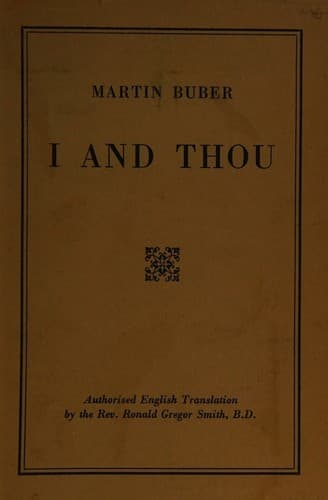
I and Thou
أنا وأنت
Je et Tu
Editorial summary
Martin Buber's "I and Thou" presents a revolutionary philosophical framework that fundamentally reconceptualizes the human relationship with the divine. The work distinguishes between two primary modes of existence: the I-Thou relationship characterized by genuine encounter and mutual presence, and the I-It relationship marked by objectification and instrumental interaction. For Buber, the question of God cannot be resolved through traditional philosophical argumentation or empirical investigation, as these approaches necessarily reduce the divine to an object of thought within the I-It paradigm.
The text argues that God represents the eternal Thou who can never become an It. Unlike finite beings that oscillate between Thou and It status in human experience, the divine maintains perpetual availability for authentic encounter. Buber contends that every genuine I-Thou relationship with finite beings ultimately points toward and participates in the relationship with the eternal Thou. This position challenges both rationalist theology, which seeks to prove God through logical demonstration, and mystical traditions that pursue union through the dissolution of individual consciousness.
Buber's methodology combines phenomenological analysis with existential insight, drawing from Hasidic tradition while engaging contemporary European philosophy. His approach directly opposes both the abstract God of philosophical theism and the distant deity of deism. Against theologians who emphasize divine transcendence at the expense of immediacy, Buber insists that God is the most present reality, encountered not through withdrawal from the world but through genuine engagement with it. The work equally critiques reductive naturalism that denies the possibility of authentic spiritual encounter.
The significance of Buber's contribution lies in reframing the God question from one of existence to one of relationship. Rather than asking whether God exists as an object among objects, Buber examines how the divine becomes present through dialogical encounter. This shift influenced subsequent developments in existential theology, personalist philosophy, and interreligious dialogue. His emphasis on the relational nature of religious experience provides a framework for understanding faith that avoids both dogmatic assertion and skeptical denial, offering instead a path grounded in lived encounter and ethical responsibility.
Argument formulations engaged
Related works
Buber, Martin (1923). I and Thou. Johns Hopkins University Press.
@book{i-and-thou-1923,
  author    = {Buber, Martin},
  title     = {I and Thou},
  year      = {1923},
  publisher = {Johns Hopkins University Press},
  url       = {https://god-database.com/en/works/i-and-thou-1923}
}