
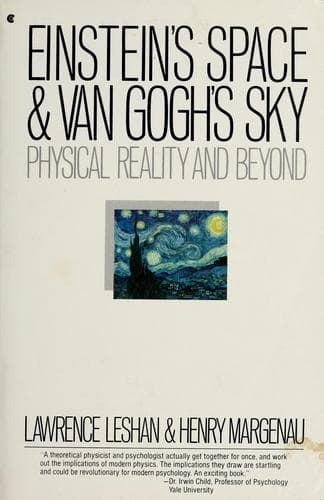
Einstein's Space and Van Gogh's Sky: Physical Reality and Beyond
فضاء أينشتاين وسماء فان جوخ: الواقع الفيزيائي وما وراءه
L'espace d'Einstein et le ciel de Van Gogh : Réalité physique et au-delà
Editorial summary
This interdisciplinary volume examines the relationship between scientific understanding of physical reality and broader questions of meaning, consciousness, and transcendence. Margenau, a physicist and philosopher of science, brings together contributions that explore how modern physics, particularly relativity and quantum mechanics, challenges conventional materialist assumptions while opening new avenues for understanding reality's deeper dimensions.
The work takes its evocative title from the juxtaposition of Einstein's mathematical description of spacetime with Van Gogh's expressive artistic vision, suggesting that complete understanding of reality requires both scientific precision and experiential depth. Contributors argue that twentieth-century physics has fundamentally altered our conception of the physical world in ways that bear on traditional metaphysical questions, including the existence and nature of God. The volume examines how quantum indeterminacy, observer-dependent measurement, and the dissolution of absolute space and time create conceptual space for non-material aspects of reality.
Central to the collection is the argument that scientific materialism, which emerged from classical physics, no longer adequately accounts for the findings of modern science itself. Several essays explore how consciousness appears to play an irreducible role in quantum mechanics, suggesting that mind cannot be eliminated from fundamental physical description. This opens possibilities for understanding consciousness as a basic feature of reality rather than an emergent property of complex material systems.
The volume engages critically with logical positivism and scientific reductionism, arguing these philosophies inappropriately constrain our understanding of reality. Contributors examine how the participatory universe revealed by quantum physics resonates with certain religious and philosophical traditions that emphasize the interconnectedness of observer and observed. While avoiding naive equations between physics and mysticism, the work suggests that modern science points toward a reality more open to transcendent dimensions than nineteenth-century mechanism allowed.
Margenau's collection represents an important contribution to science-religion dialogue by demonstrating how developments within physics itself challenge purely materialist worldviews. Rather than defending traditional theism directly, the volume creates intellectual space for non-reductive understandings of reality that include consciousness, meaning, and possibly transcendent dimensions as irreducible features. The work's significance lies in showing how careful attention to contemporary physics can inform rather than foreclose questions about ultimate reality and divine presence.
Argument formulations engaged
Margenau, Henry (1982). Einstein's Space and Van Gogh's Sky: Physical Reality and Beyond. Macmillan.
@book{einsteins-space-and-van-goghs-sky-physic,
  author    = {Margenau, Henry},
  title     = {Einstein's Space and Van Gogh's Sky: Physical Reality and Beyond},
  year      = {1982},
  publisher = {Macmillan},
  url       = {https://god-database.com/en/works/einsteins-space-and-van-goghs-sky-physical-reality-and-beyond-1982}
}