
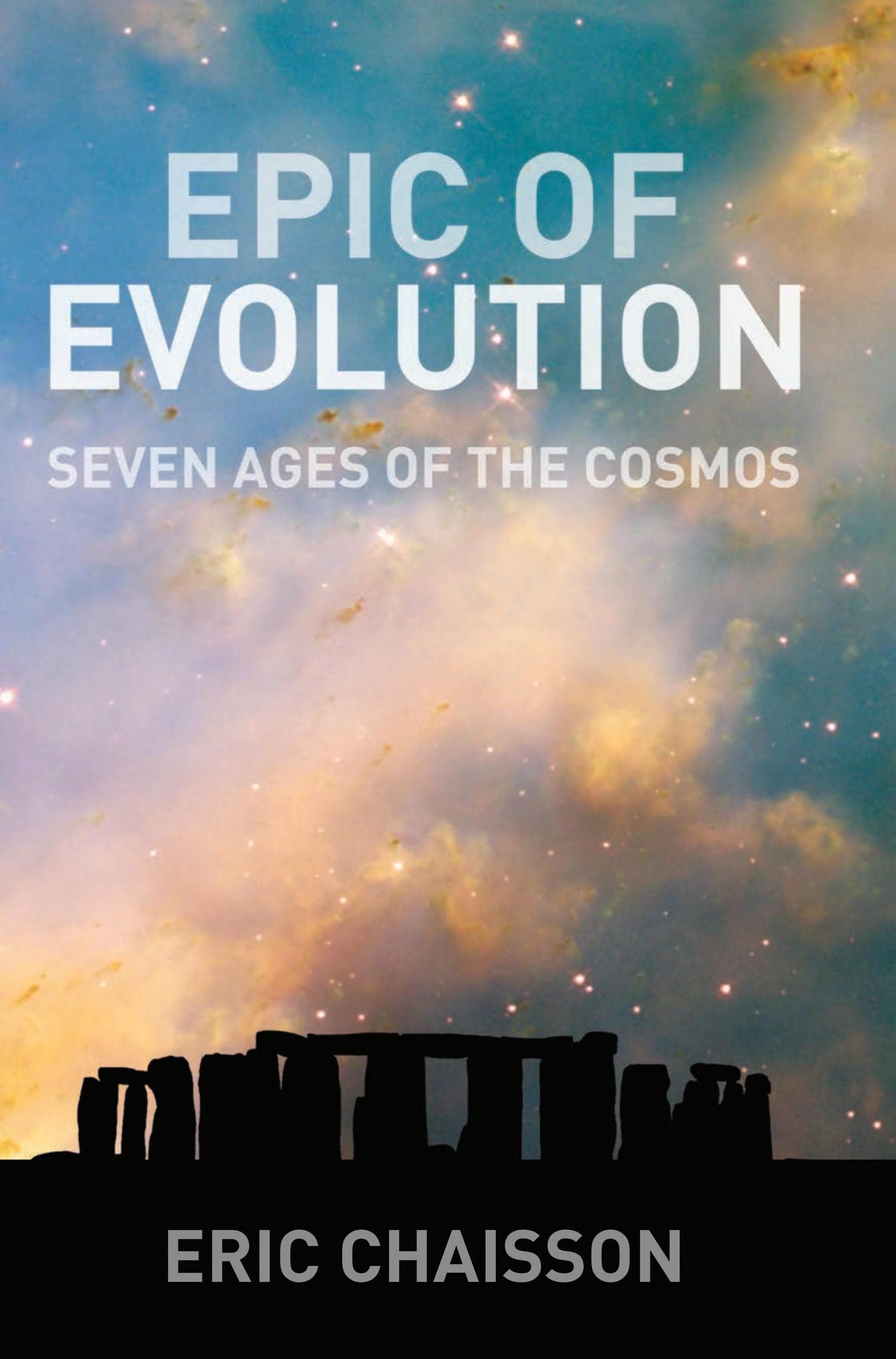
Epic of Evolution.. Seven Ages of the Cosmos
ملحمة التطور.. سبعة عصور للكون
L'épopée de l'évolution.. Les sept âges du cosmos
The universe unfolds across seven successive ages of increasing complexity, and this grand evolutionary narrative — from Big Bang to biosphere to mind — constitutes a secular cosmic epic that implicitly addresses questions of origin, purpose, and ultimate meaning.
Editorial summary
Eric Chaisson's "Epic of Evolution: Seven Ages of the Cosmos" presents a comprehensive scientific narrative of cosmic evolution from the Big Bang to the emergence of complex life and human consciousness. This work engages with fundamental questions about the nature of reality and humanity's place within it, offering a naturalistic account that intersects significantly with theological debates about cosmic purpose and design.
Chaisson structures his analysis around seven evolutionary epochs: particulate, galactic, stellar, planetary, chemical, biological, and cultural. Through this framework, he traces the increasing complexity of matter and energy across cosmic history, emphasizing the role of energy flow and thermodynamic principles in driving evolutionary change. His methodology combines astrophysics, chemistry, biology, and anthropology to construct what he terms a "grand synthesis" of scientific knowledge about cosmic evolution.
The work's engagement with the God debate operates primarily through its treatment of cosmic order and apparent directionality. While Chaisson does not explicitly argue against theistic interpretations, his naturalistic framework provides alternative explanations for phenomena often cited in support of divine design. His discussion of cosmic constants and the conditions necessary for complexity addresses fine-tuning arguments, suggesting that natural processes alone can account for the universe's life-permitting properties. Similarly, his treatment of emergent complexity offers a scientific response to cosmological arguments about the origins of order and purpose.
Chaisson's approach reflects the influence of Carl Sagan and other scientific popularizers who seek to find meaning and wonder within naturalistic worldviews. He emphasizes that scientific understanding need not diminish human significance or cosmic awe, positioning his "epic" as a modern creation story grounded in empirical evidence rather than religious tradition. This perspective places him within ongoing dialogues between scientific materialism and religious worldviews about ultimate questions of meaning and purpose.
The work's significance lies in its comprehensive integration of scientific disciplines to address questions traditionally reserved for theology and philosophy. By presenting cosmic evolution as an interconnected narrative of increasing complexity, Chaisson provides resources for those seeking to understand existence through purely natural processes while acknowledging the profound questions such a view raises about consciousness, purpose, and human destiny.
Structured analysis
Structure of the work
Argument formulations engaged
Related works
Chaisson, Eric (2005). Epic of Evolution.. Seven Ages of the Cosmos.
@book{epic-of-evolution-seven-ages-of-the-cosm,
  author    = {Chaisson, Eric},
  title     = {Epic of Evolution.. Seven Ages of the Cosmos},
  year      = {2005},
  url       = {https://god-database.com/en/works/epic-of-evolution-seven-ages-of-the-cosmos}
}