
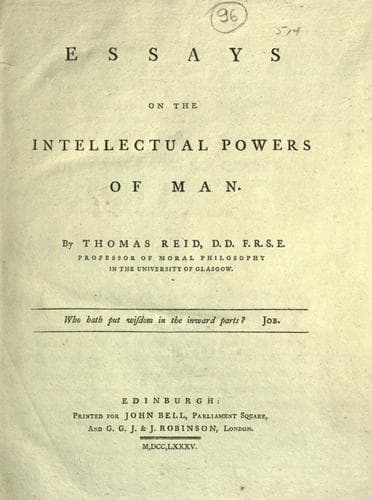
Essays on the Intellectual Powers of Man
مقالات في القوى الفكرية للإنسان
Essais sur les pouvoirs intellectuels de l'homme
Editorial summary
Thomas Reid's "Essays on the Intellectual Powers of Man" (1785) represents a pivotal intervention in 18th-century epistemology with significant implications for natural theology and philosophical arguments about God's existence. Written as a systematic response to David Hume's skepticism, this work establishes the foundations of Scottish Common Sense philosophy while defending the reliability of human faculties that underpin religious belief.
Reid's central argument targets what he perceives as the destructive consequences of the "way of ideas" championed by Descartes, Locke, Berkeley, and especially Hume. He contends that this philosophical tradition, by interposing "ideas" between the mind and reality, inevitably leads to skepticism about the external world, other minds, and ultimately God. Against this, Reid proposes that human beings possess certain fundamental principles of common sense—what he terms "first principles"—that require no proof and serve as the foundation for all reasoning.
The work's relevance to the God debate emerges through Reid's defense of intuitive knowledge and the trustworthiness of human cognitive faculties. He argues that just as we have immediate, non-inferential knowledge of the external world through perception, we possess similar intuitive awareness of moral truths and the existence of other minds. This epistemological framework provides crucial support for natural theology by validating the cognitive processes through which humans apprehend evidence of divine design and moral obligation.
Reid specifically addresses religious knowledge in his discussion of testimony and the evidence of consciousness. He maintains that the same faculties that deliver reliable information about the physical world also support reasonable belief in God. His treatment of causation directly challenges Hume's critique of the cosmological argument, asserting that our notion of power and efficient causation, derived from immediate consciousness of our own agency, legitimately extends to understanding God as the ultimate cause.
The work's methodological contribution lies in its empirical approach combined with principled resistance to reductionism. Reid insists that philosophy must begin with careful observation of how the human mind actually operates rather than with abstract theories about how it should work. This approach preserves space for religious belief within a scientifically respectable framework, arguing that skepticism about God often results from philosophical systems that arbitrarily restrict the scope of legitimate knowledge. His influence extends through subsequent defenders of theistic philosophy who adopt his common-sense methodology to ground religious epistemology.
Argument formulations engaged
Related works
Reid, Thomas (1785). Essays on the Intellectual Powers of Man. Edinburgh University Press.
@book{essays-on-the-intellectual-powers-of-man,
  author    = {Reid, Thomas},
  title     = {Essays on the Intellectual Powers of Man},
  year      = {1785},
  publisher = {Edinburgh University Press},
  url       = {https://god-database.com/en/works/essays-on-the-intellectual-powers-of-man-1785}
}