
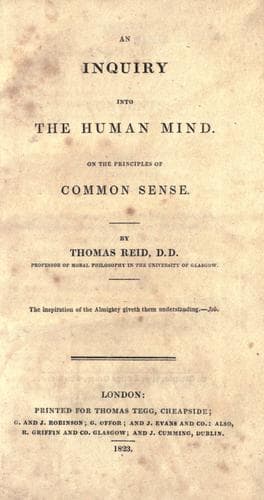
An Inquiry into the Human Mind
بحث في العقل الإنساني
Enquête sur l'esprit humain
Editorial summary
Reid's "An Inquiry into the Human Mind" advances a distinctive philosophy of common sense that carries significant implications for natural theology and religious epistemology. Writing against the skeptical conclusions of David Hume, Reid develops a theory of perception and knowledge that preserves the reliability of human faculties in apprehending both the natural world and divine reality.
The work's central contribution to the God debate emerges through Reid's critique of the "ideal theory" that dominated modern philosophy from Descartes through Hume. Reid argues that this theory, which interposes ideas between the mind and external reality, inevitably leads to skepticism about the external world, other minds, and ultimately God. By rejecting the premise that we perceive only ideas rather than things themselves, Reid seeks to restore confidence in the human capacity to know reality, including divine reality.
Reid's method combines careful phenomenological analysis with appeals to the universal consent of mankind. He argues that certain beliefs are embedded in the constitution of human nature itself, planted there by the Creator. These include belief in the external world, the reliability of our faculties, and basic moral principles. Significantly, Reid includes belief in God among these constitutional principles of common sense, arguing that the tendency to recognize divine agency in nature represents a natural disposition of the human mind rather than a product of reasoning or education.
The theological significance of Reid's position becomes clear in his treatment of natural signs and the evidence of design. He maintains that the human mind naturally interprets the order and beauty of creation as signs of divine intelligence, just as it naturally interprets facial expressions as signs of mental states. This immediate recognition of God through creation does not depend on complex arguments but operates through the same reliable faculties that guide everyday life.
Reid's influence on subsequent natural theology proves substantial, particularly in the Scottish Common Sense tradition. His epistemology provides a foundation for resisting both skeptical and fideistic approaches to religious knowledge. By grounding knowledge of God in the same common sense principles that underwrite all human knowledge, Reid offers a middle path between rationalist proofs and mystical appeals, arguing that recognition of divine reality represents a natural function of properly functioning human faculties.
Argument formulations engaged
Related works
Reid, Thomas (1764). An Inquiry into the Human Mind. The Pennsylvania State University Press.
@book{an-inquiry-into-the-human-mind-1764,
  author    = {Reid, Thomas},
  title     = {An Inquiry into the Human Mind},
  year      = {1764},
  publisher = {The Pennsylvania State University Press},
  url       = {https://god-database.com/en/works/an-inquiry-into-the-human-mind-1764}
}