
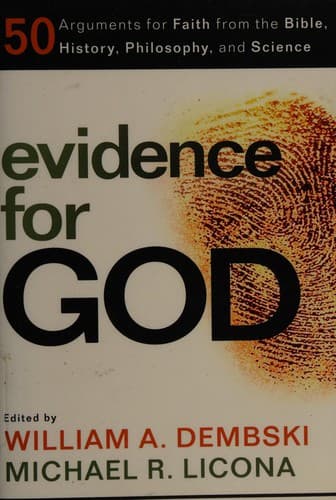
Evidence for God: 50 Arguments for Faith from the Bible, History, Philosophy, and Science
دليل على الله: 50 حجة للإيمان من الكتاب المقدس والتاريخ والفلسفة والعلم
Preuves de Dieu : 50 arguments pour la foi tirés de la Bible, de l'histoire, de la philosophie et de la science
Editorial summary
This volume presents fifty distinct arguments supporting theistic belief, drawing from biblical studies, historical analysis, philosophy, and scientific inquiry. Editor Michael R. Licona assembles contributions from various scholars who collectively build a cumulative case for God's existence and the truth of Christian theism. The work represents a comprehensive apologetic effort, engaging contemporary skepticism while defending traditional religious claims through multiple disciplinary lenses.
The collection organizes its arguments across four major domains. Biblical contributions examine manuscript evidence, archaeological corroboration, and prophetic fulfillment, arguing that scripture demonstrates divine authorship through its historical reliability and predictive accuracy. Historical essays focus particularly on Jesus Christ, defending the resurrection through analysis of early sources, eyewitness testimony, and the transformation of the disciples. These contributors employ standard historiographical methods while challenging naturalistic presuppositions that exclude miraculous explanations a priori.
Philosophical arguments revisit classical theistic proofs while incorporating contemporary developments. Contributors present versions of the cosmological argument addressing infinite regress and contingency, teleological arguments updated with fine-tuning data, and moral arguments grounded in objective value theory. Several essays engage specific atheistic objections, including the problem of evil and divine hiddenness, offering theodicies and defenses that attempt to reconcile suffering with divine benevolence.
Scientific contributions examine biological complexity, cosmic origins, and consciousness, arguing these phenomena point toward intelligent design rather than unguided processes. Authors critique methodological naturalism as an arbitrary constraint on scientific inquiry while proposing that theism provides superior explanatory resources for understanding nature's order and intelligibility.
The volume's significance lies in its systematic presentation of theistic arguments across multiple disciplines, demonstrating how diverse fields of inquiry can converge on religious conclusions. By combining traditional apologetic strategies with engagement of contemporary scholarship, the work serves both pastoral and academic purposes. It provides believers with intellectual resources for defending faith while challenging secular academics to reconsider dismissive attitudes toward religious claims.
Critics might note the volume's exclusively Christian perspective and absence of non-theistic contributors, potentially limiting genuine dialogue. Nevertheless, the work represents a substantial contribution to natural theology and Christian apologetics, illustrating how theistic scholars marshal evidence from various domains to support religious belief. Its comprehensive scope makes it valuable for understanding contemporary arguments in favor of God's existence and Christianity's truth claims.
Argument formulations engaged
Related works
Licona, Michael R. (2010). Evidence for God: 50 Arguments for Faith from the Bible, History, Philosophy, and Science. Baker Books.
@book{evidence-for-god-50-arguments-for-faith-,
  author    = {Licona, Michael R.},
  title     = {Evidence for God: 50 Arguments for Faith from the Bible, History, Philosophy, and Science},
  year      = {2010},
  publisher = {Baker Books},
  url       = {https://god-database.com/en/works/evidence-for-god-50-arguments-for-faith-from-the-bible-history-philosophy-and-science-2010}
}