
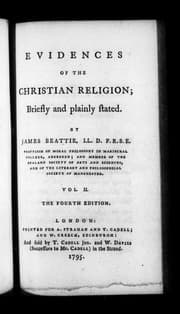
Evidences of the Christian Religion
براهين الديانة المسيحية
Preuves de la religion chrétienne
Editorial summary
Beattie's "Evidences of the Christian Religion" presents a systematic defense of Christianity's truth claims through an appeal to both empirical evidence and rational argumentation. Writing in the late eighteenth century, Beattie positions himself against the rising tide of skeptical philosophy, particularly targeting David Hume's critiques of miracles and religious knowledge. The work exemplifies the Scottish Common Sense school's approach to religious apologetics, emphasizing the reliability of ordinary human faculties in apprehending divine truth.
The monograph develops its case through several interconnected arguments. Beattie first establishes the historical credibility of biblical testimony, arguing that the Gospel accounts satisfy the same evidentiary standards applied to secular historical texts. He particularly emphasizes the character and circumstances of the apostolic witnesses, contending that their willingness to suffer for their testimony demonstrates their sincerity and the authenticity of their experiences. Against Humean skepticism about miracles, Beattie maintains that extraordinary events require extraordinary evidence rather than categorical rejection, and that the convergent testimony of multiple independent witnesses provides such evidence.
Central to Beattie's method is his appeal to what he terms "moral evidence" - the cumulative force of various probabilistic arguments that, while individually inconclusive, collectively establish Christianity's truth beyond reasonable doubt. He examines fulfilled prophecies, the rapid spread of Christianity despite persecution, and the religion's beneficial moral effects as corroborating evidence for its divine origin. Throughout, Beattie employs the Common Sense philosophy's characteristic trust in intuitive judgments and rejection of philosophical paradoxes that contradict ordinary experience.
The work's significance lies in its representation of mainstream Protestant apologetics during the Scottish Enlightenment. Beattie attempts to navigate between enthusiasm and skepticism, offering a moderate rational Christianity that acknowledges reason's limits while maintaining its essential role in religious belief. His arguments anticipate later evidentialist approaches to Christian apologetics, particularly in their emphasis on historical investigation and cumulative case reasoning. While contemporary philosophers largely rejected Beattie's refutation of Hume as philosophically inadequate, his work influenced popular religious thought and demonstrates how Christian intellectuals sought to defend traditional faith using Enlightenment methods. The monograph thus illuminates the period's debates about the relationship between reason, evidence, and religious belief.
Argument formulations engaged
Related works
Beattie, James (1786). Evidences of the Christian Religion. Jazzybee Verlag.
@book{evidences-of-the-christian-religion-1786,
  author    = {Beattie, James},
  title     = {Evidences of the Christian Religion},
  year      = {1786},
  publisher = {Jazzybee Verlag},
  url       = {https://god-database.com/en/works/evidences-of-the-christian-religion-1786}
}