
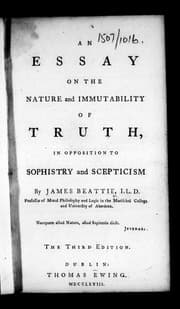
An Essay on the Nature and Immutability of Truth
مقال في طبيعة الحقيقة وثباتها
Essai sur la nature et l'immutabilité de la vérité
Editorial summary
James Beattie's "An Essay on the Nature and Immutability of Truth" represents a vigorous defense of common sense philosophy against the skepticism of David Hume, with significant implications for natural theology and religious belief. Writing in 1770, Beattie positions himself as a champion of ordinary human intuitions about truth, reality, and morality, arguing that these fundamental convictions require no philosophical justification and indeed resist skeptical dissolution.
The work directly challenges Hume's empiricism and its corrosive effects on religious faith. Beattie contends that certain truths are self-evident and immediately perceived by what he terms "common sense" — a faculty distinct from reason that provides direct access to fundamental realities. Among these self-evident truths, Beattie includes the existence of the external world, the reliability of memory, the principle of causation, and crucially, the existence of God. He argues that skeptical philosophy, by undermining these basic certainties, threatens not only theoretical knowledge but practical morality and social order.
Beattie's method combines philosophical argumentation with rhetorical appeal to shared human experience. He systematically examines Humean skepticism across multiple domains — perception, causation, personal identity, and moral distinctions — demonstrating what he views as its absurd consequences. The essay particularly emphasizes how skepticism about causation undermines the cosmological argument for God's existence, while moral skepticism erodes the foundations of virtue and social obligation. Against Hume's reduction of belief to custom and habit, Beattie insists on the rational and divinely implanted nature of common sense principles.
The theological significance of Beattie's project emerges clearly in his treatment of natural religion. He maintains that belief in God arises spontaneously from the ordinary operations of the human mind observing the order and design of nature. This belief requires no complex philosophical proofs but rather protection from sophisticated skeptical arguments that contradict universal human experience. Beattie thus contributes to the God debate by defending a form of natural theology grounded in common sense realism rather than elaborate metaphysical demonstration.
While later philosophers would criticize Beattie's conflation of psychological certainty with philosophical truth, his essay exercised considerable influence in its time, particularly in Scotland and America. The work exemplifies the Scottish Common Sense school's attempt to preserve traditional religious and moral convictions within an empiricist framework, offering a populist philosophical defense of theistic belief against enlightenment skepticism.
Argument formulations engaged
Related works
Beattie, James (1770). An Essay on the Nature and Immutability of Truth.
@book{an-essay-on-the-nature-and-immutability-,
  author    = {Beattie, James},
  title     = {An Essay on the Nature and Immutability of Truth},
  year      = {1770},
  url       = {https://god-database.com/en/works/an-essay-on-the-nature-and-immutability-of-truth-1770}
}