
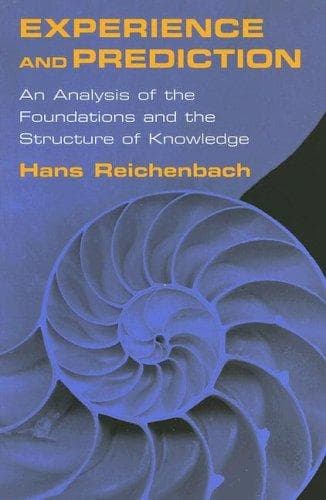
Experience and Prediction
التجربة والتنبؤ
Expérience et prédiction
Editorial summary
This foundational work in logical empiricism articulates Hans Reichenbach's systematic philosophy of science, developing a naturalistic epistemology that has significant implications for theological discourse. While primarily concerned with establishing the methodological foundations of empirical knowledge, Experience and Prediction advances arguments that challenge traditional metaphysical approaches to questions about God and ultimate reality.
Reichenbach constructs his philosophical system on the distinction between the context of discovery and the context of justification, arguing that only the latter falls within philosophy's proper domain. This methodological stance effectively excludes theological speculation from legitimate philosophical inquiry, as religious experiences and revelatory claims belong to the psychological context of discovery rather than the logical context of justification. The work develops a probabilistic theory of knowledge that replaces certainty with degrees of confirmation, undermining classical proofs for God's existence that depend on necessary truths or absolute foundations.
The monograph's treatment of meaning through its verificationist approach poses particular challenges to theological language. Reichenbach argues that meaningful statements must be reducible to observable consequences, rendering many traditional theological claims cognitively meaningless. His analysis of causation as statistical correlation rather than necessary connection further erodes metaphysical arguments that move from contingent facts to necessary beings. The work's commitment to extensionalism—the view that meaning derives from reference rather than intention—creates additional difficulties for religious language that often depends on analogical or symbolic modes of expression.
Reichenbach's pragmatic approach to truth and his emphasis on prediction as the goal of knowledge reflect a thoroughly naturalistic worldview. While he avoids explicit atheistic pronouncements, his philosophical framework systematically excludes supernatural explanations from scientific discourse. The work's influence on subsequent philosophy of science helped establish methodological naturalism as the default position in scientific inquiry, effectively bracketing theological considerations from empirical investigation.
Experience and Prediction matters to the God debate not through direct engagement with theological arguments but through its articulation of epistemological standards that render such arguments philosophically suspect. Reichenbach's rigorous empiricism and his reduction of knowledge to probabilistic predictions about observable phenomena represent a comprehensive alternative to worldviews that include transcendent realities. His work exemplifies how logical empiricism sought to dissolve rather than solve traditional metaphysical problems, including questions about divine existence.
Argument formulations engaged
Related works
Reichenbach, Hans (1938). Experience and Prediction. Phoenix Books The University of Chicago Press.
@book{experience-and-prediction-1938,
  author    = {Reichenbach, Hans},
  title     = {Experience and Prediction},
  year      = {1938},
  publisher = {Phoenix Books The University of Chicago Press},
  url       = {https://god-database.com/en/works/experience-and-prediction-1938}
}