
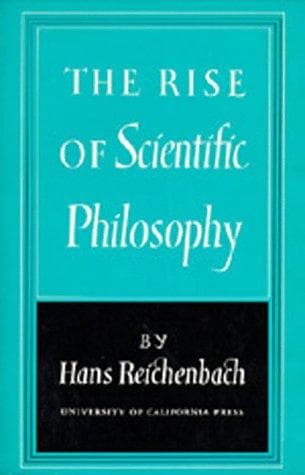
The Rise of Scientific Philosophy
نهوض الفلسفة العلمية
L'Essor de la philosophie scientifique
Editorial summary
Hans Reichenbach's The Rise of Scientific Philosophy represents a systematic attempt to demonstrate how scientific methodology supersedes traditional philosophical approaches to fundamental questions, including those concerning God and metaphysics. Writing in the wake of logical positivism's ascendancy, Reichenbach argues that philosophy must abandon its speculative tendencies and align itself with the empirical methods that have proven successful in the natural sciences.
The work traces the historical development of philosophical thought from ancient speculation through medieval theology to modern scientific reasoning. Reichenbach contends that traditional philosophy, particularly in its treatment of theological questions, has been mired in meaningless pseudo-problems that arise from linguistic confusion and a failure to distinguish between empirically verifiable claims and empty metaphysical assertions. He maintains that questions about God's existence, divine attributes, and supernatural causation represent precisely the kind of unverifiable speculation that scientific philosophy must reject.
Central to Reichenbach's argument is his distinction between cognitive meaning and emotive expression. Religious and theological statements, he argues, may possess emotional or aesthetic significance but lack cognitive content because they cannot be subjected to empirical verification or logical analysis. The book develops this critique through detailed examination of how scientific method has progressively displaced theological explanation in astronomy, physics, biology, and psychology.
Reichenbach's methodology combines logical analysis with historical survey, demonstrating how each advance in scientific understanding has correspondingly reduced the explanatory role attributed to divine action. He argues that probability theory and inductive logic provide the only reliable tools for knowledge acquisition, effectively excluding revelation, intuition, and faith as legitimate sources of truth claims.
The work engages critically with both traditional natural theology and contemporary attempts to reconcile science with religion. Reichenbach rejects not only crude anthropomorphic conceptions of deity but also sophisticated philosophical arguments for God's existence, including cosmological and teleological proofs. He contends that modern physics, particularly quantum mechanics and relativity theory, eliminates any meaningful role for supernatural explanation.
This monograph significantly influenced mid-twentieth century discussions about the relationship between science and religion, articulating a position that would shape subsequent naturalistic philosophy. Its uncompromising stance that scientific method alone provides genuine knowledge effectively removes theological questions from the domain of rational inquiry, treating them as remnants of prescientific thinking.
Argument formulations engaged
Related works
Reichenbach, Hans (1951). The Rise of Scientific Philosophy.
@book{the-rise-of-scientific-philosophy-1951,
  author    = {Reichenbach, Hans},
  title     = {The Rise of Scientific Philosophy},
  year      = {1951},
  url       = {https://god-database.com/en/works/the-rise-of-scientific-philosophy-1951}
}