
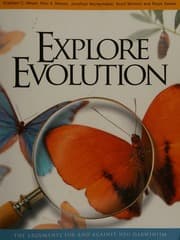
Explore Evolution: The Arguments For and Against Neo-Darwinism
استكشاف التطور: الحجج مع ومضد الداروينية الجديدة
Explorer l'évolution : Les arguments pour et contre le néo-darwinisme
Editorial summary
This textbook presents itself as an inquiry-based exploration of contemporary evolutionary theory, specifically examining arguments both supporting and challenging neo-Darwinian mechanisms. Meyer and his co-authors structure the work around five key areas of debate: the fossil record, anatomical homology, molecular evidence, the origin of biological information, and macroevolutionary change. The text adopts a pedagogical approach that encourages students to evaluate competing scientific explanations rather than accepting any single interpretive framework.
The work systematically presents mainstream evolutionary explanations alongside alternative interpretations of the same evidence. For instance, regarding the Cambrian explosion, the authors detail both conventional evolutionary accounts of gradual diversification and arguments suggesting the rapid appearance of complex body plans poses explanatory challenges for neo-Darwinian mechanisms. Similarly, discussions of molecular homology examine both evidence supporting common descent and anomalies that some scientists argue complicate simple evolutionary narratives.
Central to the text's methodology is its claimed commitment to teaching scientific inquiry skills through examining an active scientific controversy. The authors position their approach as promoting critical thinking by exposing students to ongoing debates within evolutionary biology. They emphasize distinguishing between empirical observations and theoretical interpretations, encouraging students to assess how well different theories account for available evidence.
The work engages with the broader dialogue about science education and the boundaries of legitimate scientific discourse. While not explicitly advocating intelligent design, the text includes criticisms of neo-Darwinism often associated with design theorists. This has generated significant controversy, with critics arguing the book misrepresents the scientific consensus and creates false equivalencies between well-established theory and fringe positions.
The textbook's significance lies primarily in its role within debates over science education policy and curriculum. Supporters view it as promoting genuine scientific inquiry and intellectual freedom, while detractors see it as introducing religiously motivated pseudoscience into classrooms under the guise of critical thinking. The work thus functions as both an educational resource and a strategic intervention in cultural conflicts over evolution, science education, and the relationship between scientific and religious worldviews. Its impact extends beyond pedagogy to broader questions about authority in determining scientific orthodoxy and the proper boundaries of classroom instruction.
Argument formulations engaged
Related works
Meyer, Stephen C. (2007). Explore Evolution: The Arguments For and Against Neo-Darwinism. Hill House Publishers.
@book{explore-evolution-the-arguments-for-and-,
  author    = {Meyer, Stephen C.},
  title     = {Explore Evolution: The Arguments For and Against Neo-Darwinism},
  year      = {2007},
  publisher = {Hill House Publishers},
  url       = {https://god-database.com/en/works/explore-evolution-the-arguments-for-and-against-neo-darwinism-2007}
}