
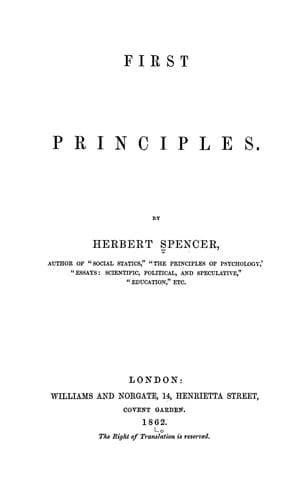
First Principles
المبادئ الأولى
Premiers principes
Editorial summary
Spencer's First Principles represents a monumental attempt to construct a comprehensive philosophical system that reconciles scientific knowledge with ultimate metaphysical questions. The work establishes evolutionary principles as the foundation for understanding all phenomena, from cosmic formation to human society, while maintaining a distinctive position on religious and theological matters.
The text articulates Spencer's doctrine of the Unknowable, which forms the philosophical cornerstone of his system. Spencer argues that human knowledge necessarily operates within the realm of the phenomenal and relative, while an absolute reality exists beyond the reach of human comprehension. This unknowable absolute, he contends, represents the legitimate object of religious sentiment, though it remains forever inaccessible to scientific or philosophical investigation. Spencer thus attempts to preserve a space for religious feeling while denying the possibility of theological knowledge.
Central to Spencer's argument is his law of evolution, which he formulates as the integration of matter accompanied by the dissipation of motion, during which matter passes from indefinite, incoherent homogeneity to definite, coherent heterogeneity. This principle, Spencer maintains, governs all transformations in the universe, from nebular condensation to the development of human consciousness and social institutions. He explicitly extends this naturalistic framework to explain phenomena traditionally attributed to divine action or design.
The work engages critically with both traditional theology and contemporary scientific materialism. Spencer rejects anthropomorphic conceptions of deity and challenges specific theological doctrines, arguing that attempts to define or characterize the absolute lead to contradictions. Simultaneously, he critiques pure materialism as philosophically inadequate, insisting that matter and force themselves point toward an unknowable reality that transcends them.
Spencer's methodology combines empirical observation with systematic deduction from first principles. He draws extensively on contemporary scientific discoveries in physics, biology, and psychology, synthesizing them within his evolutionary framework. His approach significantly influenced subsequent debates about naturalism and the limits of scientific explanation.
The work's contribution to discussions of God lies in its sophisticated attempt to preserve religious sentiment while evacuating traditional theological content. Spencer's agnosticism differs from simple skepticism by affirming the existence of an absolute reality while denying the possibility of knowing its nature. This position would profoundly influence later Victorian debates about science and religion, offering a middle path that neither affirms nor denies God's existence but declares the question unanswerable.
Argument formulations engaged
Spencer, Herbert (1862). First Principles. Sutton Press.
@book{first-principles-1862,
  author    = {Spencer, Herbert},
  title     = {First Principles},
  year      = {1862},
  publisher = {Sutton Press},
  url       = {https://god-database.com/en/works/first-principles-1862}
}