
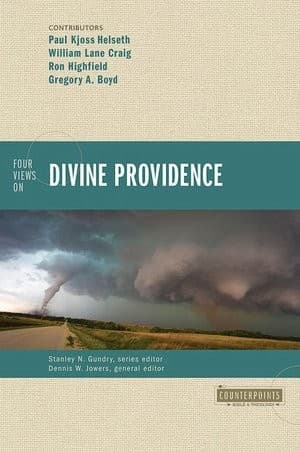
Four Views on Divine Providence
أربع وجهات نظر حول العناية الإلهية
Quatre points de vue sur la providence divine
Editorial summary
This edited volume presents four competing theological perspectives on divine providence, examining how God governs creation and interacts with human affairs. The work structures a systematic dialogue between prominent evangelical scholars who defend distinct positions: God causes all things (Paul Kjoss Helseth), God directs all things (William Lane Craig), God controls by liberating (Roger E. Olson), and God limits divine control (Gregory A. Boyd). Each contributor presents their model through careful biblical exegesis, philosophical argumentation, and theological reflection, followed by responses from the other three scholars.
The volume addresses fundamental questions about the nature and extent of God's sovereignty, particularly regarding human freedom, evil, and divine foreknowledge. Helseth articulates a Reformed position emphasizing God's meticulous sovereignty over all events, including human choices. Craig defends a Molinist framework wherein God achieves providential control through middle knowledge of counterfactuals of creaturely freedom. Olson presents an Arminian perspective that preserves libertarian free will while maintaining God's ultimate purposes. Boyd advocates open theism, arguing that God voluntarily limits divine foreknowledge to preserve genuine human freedom and divine-human relationships.
The work's significance lies in its systematic comparison of these positions within evangelical theology. Rather than presenting abstract philosophical arguments, each author grounds their view in scriptural interpretation and addresses practical implications for prayer, suffering, and Christian living. The format facilitates direct engagement between incompatible theological systems that share common evangelical commitments to biblical authority and orthodox theism.
The debate illuminates deeper methodological differences regarding how to balance biblical texts emphasizing divine sovereignty with those affirming human responsibility. It also reveals varying approaches to reconciling classical theistic attributes with biblical narratives depicting divine responsiveness and change. The volume serves as a comprehensive introduction to contemporary evangelical debates about providence while demonstrating how theological method shapes conclusions about God's relationship to creation.
This work contributes to the God debate by clarifying how different conceptions of divine action relate to perennial problems of evil, prayer, and human freedom. It shows that even within a shared theistic framework, fundamental disagreements persist about God's nature and involvement in temporal affairs. The scholarly exchange format allows readers to evaluate the relative strengths and weaknesses of each position through direct comparison and critique.
Argument formulations engaged
Gundry, Stanley N. (2011). Four Views on Divine Providence. Zondervan.
@book{four-views-on-divine-providence-2011,
  author    = {Gundry, Stanley N.},
  title     = {Four Views on Divine Providence},
  year      = {2011},
  publisher = {Zondervan},
  url       = {https://god-database.com/en/works/four-views-on-divine-providence-2011}
}