
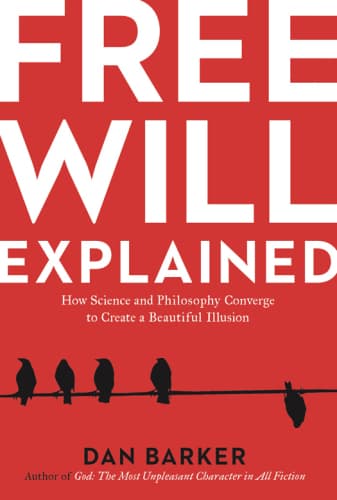
Free Will Explained: How Science and Philosophy Converge to Create a Beautiful Illusion
الإرادة الحرة مفسرة: كيف يتقارب العلم والفلسفة لخلق وهم جميل
Le libre arbitre expliqué : Comment la science et la philosophie convergent pour créer une belle illusion
Editorial summary
Dan Barker's Free Will Explained: How Science and Philosophy Converge to Create a Beautiful Illusion presents a naturalistic account of human agency that challenges theistic arguments from free will. Drawing on neuroscience, evolutionary psychology, and philosophical analysis, Barker argues that what humans experience as free will is actually a sophisticated neural phenomenon—a "beautiful illusion" produced by brain processes rather than evidence of divine design or supernatural soul.
The work directly engages theological libertarianism, which posits that genuine free will requires a non-physical soul granted by God. Barker systematically dismantles this position by examining contemporary neuroscientific findings, particularly Benjamin Libet's experiments and subsequent research showing that unconscious brain activity precedes conscious decision-making. He argues these discoveries support a compatibilist framework where human choices, while determined by prior causes, remain meaningful within naturalistic parameters.
Barker's methodology combines scientific exposition with philosophical argumentation, making complex neuroscientific research accessible while maintaining analytical rigor. He addresses the theological implications of determinism, arguing that moral responsibility can exist without libertarian free will—a direct challenge to religious arguments that link ethics to divine command or spiritual freedom. The author particularly targets the Christian apologetic tradition that uses free will to explain the problem of evil, demonstrating how this theodicy collapses under scientific scrutiny.
The monograph's significance lies in its systematic integration of empirical findings with philosophical theology. Barker, a former evangelical preacher turned atheist activist, brings unique perspective to debates typically dominated by either scientists dismissive of philosophical nuance or theologians unfamiliar with neuroscientific literature. His work contributes to the growing convergence between cognitive science and philosophy of religion, offering naturalistic explanations for phenomena traditionally cited as evidence for God.
While engaging respectfully with theistic philosophers like Alvin Plantinga and Richard Swinburne, Barker ultimately presents free will as evidence against rather than for theism. He contends that understanding agency as an evolved biological phenomenon eliminates the explanatory need for supernatural intervention. The work thus advances atheistic philosophy by demonstrating how scientific materialism can account for human experiences previously thought to require religious explanation, while maintaining that this "illusion" of free will remains functionally important for human flourishing.
Argument formulations engaged
Barker, Dan (2018). Free Will Explained: How Science and Philosophy Converge to Create a Beautiful Illusion. Sterling.
@book{free-will-explained-how-science-and-phil,
  author    = {Barker, Dan},
  title     = {Free Will Explained: How Science and Philosophy Converge to Create a Beautiful Illusion},
  year      = {2018},
  publisher = {Sterling},
  url       = {https://god-database.com/en/works/free-will-explained-how-science-and-philosophy-converge-to-create-a-beautiful-illusion-2018}
}