
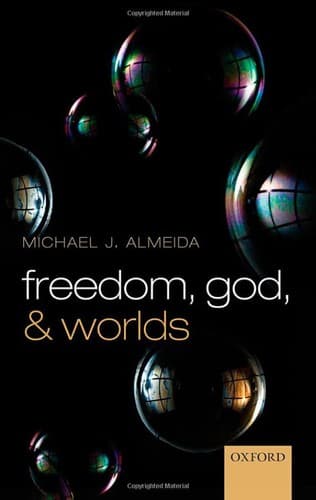
Freedom, God, and Worlds
الحرية والله والعوالم
Liberté, Dieu et mondes
Editorial summary
This monograph examines the fundamental tension between divine perfection and human freedom through rigorous analysis of possible worlds semantics. Almeida challenges the widespread assumption that God's perfect goodness necessarily constrains divine action to creating only the best possible worlds, arguing instead that genuine human freedom requires God to permit the actualization of less-than-optimal worlds.
The work engages critically with contemporary perfect being theology, particularly the arguments of Thomas Morris, Richard Swinburne, and William Rowe. Against these thinkers, Almeida contends that their conceptions of divine perfection ultimately eliminate meaningful human freedom by reducing creatures to mere executors of a divinely predetermined optimal plan. The author develops a sophisticated modal framework demonstrating how God's perfection remains compatible with divine choices that appear suboptimal from a purely consequentialist perspective.
Central to Almeida's argument is his distinction between two types of divine perfection: essential perfection (God's necessary attributes) and contingent perfection (God's free actions). He argues that while God's essential nature includes perfect goodness, this does not entail that God must actualize the best possible world, if such exists. Through careful analysis of counterfactuals of freedom, the monograph shows how genuine libertarian freedom requires that God sometimes permit outcomes that an omnipotent being could have prevented.
The methodological approach combines analytic philosophy of religion with modal logic, employing precise formal tools to clarify traditionally murky theological concepts. Almeida dedicates substantial attention to the problem of divine freedom itself, arguing that if God must create the best possible world, then God lacks significant freedom. This creates a parallel between human and divine freedom that strengthens his overall thesis.
The work's most significant contribution lies in its sophisticated defense of the compatibility between robust human freedom and divine perfection without retreating to skeptical theism or abandoning classical divine attributes. Almeida demonstrates that theodicy need not choose between an omnibenevolent God and meaningful human agency. His arguments have important implications for discussions of the problem of evil, divine hiddenness, and the nature of divine-human relationships.
The monograph represents a major intervention in analytic philosophy of religion, offering theists conceptual resources for maintaining traditional divine attributes while preserving genuine human freedom. Its technical rigor and philosophical sophistication establish new parameters for future discussions of divine perfection and modal theology.
Argument formulations engaged
Related works
Almeida, Michael (2012). Freedom, God, and Worlds. Oxford University Press.
@book{freedom-god-and-worlds-2012,
  author    = {Almeida, Michael},
  title     = {Freedom, God, and Worlds},
  year      = {2012},
  publisher = {Oxford University Press},
  url       = {https://god-database.com/en/works/freedom-god-and-worlds-2012}
}