
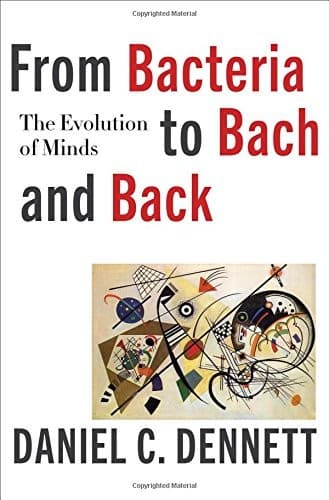
From Bacteria to Bach and Back: The Evolution of Minds
من البكتيريا إلى باخ والعودة: تطور العقول
Des bactéries à Bach et retour : L'évolution des esprits
Editorial summary
Daniel Dennett's From Bacteria to Bach and Back presents a comprehensive naturalistic account of consciousness and human cognition, arguing that minds emerge through purely evolutionary processes without requiring divine intervention or irreducible mental properties. The work extends Dennett's career-long project of explaining consciousness through Darwinian mechanisms, offering his most detailed treatment of how "competence without comprehension" gradually produces the illusion of understanding.
The book traces cognitive evolution from simple bacterial responses to human cultural achievements, employing what Dennett calls "thinking tools" - conceptual devices that help dissolve philosophical puzzles about consciousness. Central to his argument is the claim that natural selection creates "reasons without reasoners" and "designs without designers," directly challenging theological arguments from design. Dennett contends that the apparent purposiveness in nature and mind requires no divine architect, emerging instead from algorithmic processes operating over vast timescales.
Particularly significant for debates about God is Dennett's treatment of human consciousness as a "user illusion" - a helpful but ultimately misleading way brains represent their own operations. This directly opposes dualist and theological accounts that posit consciousness as evidence for immaterial souls or divine sparks. By explaining away the felt specialness of human awareness, Dennett undermines what many consider the last refuge of supernatural explanation in human nature.
The work engages critically with philosophers like Thomas Nagel and David Chalmers who maintain that consciousness presents "hard problems" potentially requiring non-physical explanations. Dennett dismisses these as pseudo-problems arising from conceptual confusion. His methodology combines empirical findings from neuroscience, cognitive science, and artificial intelligence with philosophical analysis, exemplifying the naturalistic approach that characterizes New Atheist critiques of religious worldviews.
While not explicitly focused on God's existence, the book systematically removes explanatory gaps where divine action might be invoked. Dennett's account of cultural evolution through "memes" extends this naturalistic explanation to religion itself, treating religious beliefs as cultural variants subject to selection pressures rather than insights into transcendent reality. The work thus contributes to atheistic philosophy by providing detailed mechanisms for phenomena traditionally attributed to divine design or intervention, from the origins of life to the heights of human creativity and spiritual experience.
Argument formulations engaged
Related works
Dennett, Daniel (2017). From Bacteria to Bach and Back: The Evolution of Minds. W. W. Norton.
@book{from-bacteria-to-bach-and-back-the-evolu,
  author    = {Dennett, Daniel},
  title     = {From Bacteria to Bach and Back: The Evolution of Minds},
  year      = {2017},
  publisher = {W. W. Norton},
  url       = {https://god-database.com/en/works/from-bacteria-to-bach-and-back-the-evolution-of-minds-2017}
}