
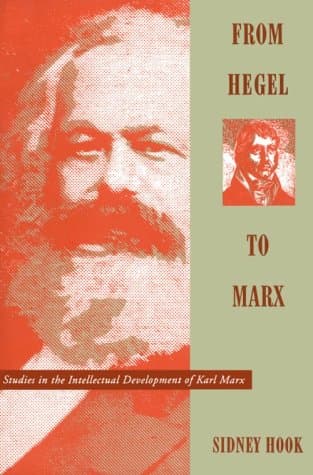
From Hegel to Marx
من هيجل إلى ماركس
De Hegel à Marx
Editorial summary
Sidney Hook's From Hegel to Marx provides a systematic examination of the philosophical transformation from Hegelian idealism to Marxist materialism, offering crucial insights into how theological questions became reconceptualized through revolutionary social theory. Hook traces the intellectual journey from Hegel's absolute idealism, where God functions as the ultimate reality manifesting through historical development, to Marx's materialist inversion that eliminates theological categories while preserving dialectical method.
The work demonstrates how the Young Hegelians, particularly Feuerbach, served as the critical bridge in this transformation. Hook analyzes Feuerbach's revolutionary thesis that theology constitutes anthropology in mystified form—that God represents humanity's alienated essence projected onto an imaginary supernatural being. This critique established the foundation for Marx's broader theory of alienation, wherein religious consciousness emerges from material conditions rather than revealing metaphysical truths.
Hook's analysis illuminates Marx's distinctive contribution: moving beyond mere religious criticism to identify the social conditions generating religious belief. Where Hegel saw history as God's self-revelation through human consciousness, Marx reconceived historical development as driven by material forces and class struggle. Hook carefully explicates how Marx retained Hegel's dialectical method while rejecting its idealist content, transforming philosophy from a tool for interpreting divine purpose into an instrument for revolutionary practice.
The monograph engages critically with both conservative Hegelians who defended traditional theism and radical interpreters who sought to democratize Hegel's philosophy. Hook situates Marx's atheism not as simple negation but as the logical culmination of Hegel's own method applied to material reality. He demonstrates how Marx's critique extends beyond rejecting God's existence to analyzing religion's social function in legitimating oppression and offering illusory compensation for earthly suffering.
Hook's contribution lies in clarifying how philosophical atheism emerged through internal critique of idealist philosophy rather than external scientific challenge. By tracing the logical development from Hegel's theological system through Feuerbach's humanistic reduction to Marx's historical materialism, Hook reveals atheism's philosophical sophistication and its connection to broader emancipatory projects. His work remains essential for understanding how modern atheism developed not merely as denial of religious claims but as part of comprehensive social criticism, establishing the framework for subsequent debates about religion's relationship to ideology, alienation, and social transformation.
Argument formulations engaged
Related works
Hook, Sidney (1936). From Hegel to Marx. Columbia University Press.
@book{from-hegel-to-marx-1936,
  author    = {Hook, Sidney},
  title     = {From Hegel to Marx},
  year      = {1936},
  publisher = {Columbia University Press},
  url       = {https://god-database.com/en/works/from-hegel-to-marx-1936}
}