
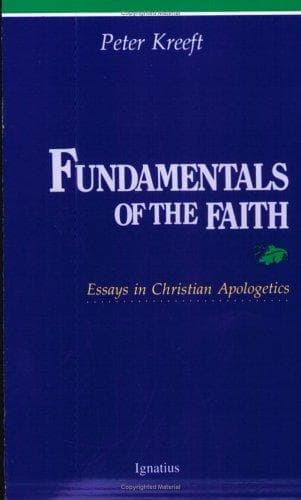
Fundamentals of the Faith: Essays in Christian Apologetics
أساسيات الإيمان: مقالات في الدفاعيات المسيحية
Fondements de la foi : Essais d'apologétique chrétienne
Editorial summary
This collection of apologetic essays presents a comprehensive defense of Christian theism through philosophical argumentation aimed at contemporary skeptics and believers alike. Peter Kreeft, writing from within the Catholic intellectual tradition, constructs a systematic case for Christianity's rational foundations while addressing modern objections to religious belief.
The work engages directly with the prevailing materialism and relativism of late twentieth-century Western culture. Kreeft challenges naturalistic assumptions by arguing that fundamental human experiences—including moral intuition, aesthetic appreciation, and the desire for transcendence—point beyond purely physical explanations. He contends that Christianity offers the most coherent account of these phenomena, providing what secular worldviews cannot: ultimate meaning, objective moral values, and hope beyond death.
Kreeft's apologetic method combines traditional philosophical arguments with accessible analogies and contemporary examples. He revisits classical proofs for God's existence, particularly the cosmological and teleological arguments, while updating them to address modern scientific objections. His treatment of the problem of evil acknowledges its emotional force while arguing that Christianity's doctrines of free will and redemption offer the most satisfactory theodicy. Throughout, he emphasizes that faith and reason complement rather than contradict each other, rejecting both fideism and rationalism in favor of a synthesis rooted in the Thomistic tradition.
The essays particularly target what Kreeft identifies as the spiritual poverty of secular humanism. He argues that attempts to preserve Christian ethics while discarding Christian metaphysics ultimately fail, leading to moral relativism and existential despair. Against postmodern skepticism about truth, he defends the possibility of objective knowledge, including knowledge of God through both natural reason and divine revelation.
Kreeft positions his work against several intellectual opponents: scientific materialism that reduces reality to physical processes, religious pluralism that denies Christianity's unique truth claims, and practical atheism that lives as if God does not exist regardless of theoretical beliefs. His argumentation draws extensively on C.S. Lewis, G.K. Chesterton, and Thomas Aquinas, continuing their project of making Christianity intellectually credible to educated moderns.
The collection's significance lies in its attempt to demonstrate that Christian theism remains philosophically viable despite secularization. Kreeft insists that the central questions of human existence—origin, purpose, morality, and destiny—find their most satisfying answers within the Christian worldview. His work exemplifies late twentieth-century Catholic apologetics, combining rigorous philosophical argument with pastoral concern for contemporary spiritual seekers.
Argument formulations engaged
Kreeft, Peter (1988). Fundamentals of the Faith: Essays in Christian Apologetics. Ignatius Press.
@book{fundamentals-of-the-faith-essays-in-chri,
  author    = {Kreeft, Peter},
  title     = {Fundamentals of the Faith: Essays in Christian Apologetics},
  year      = {1988},
  publisher = {Ignatius Press},
  url       = {https://god-database.com/en/works/fundamentals-of-the-faith-essays-in-christian-apologetics-1988}
}