
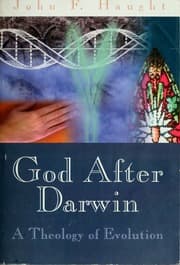
God After Darwin: A Theology of Evolution
الله بعد داروين: لاهوت التطور
Dieu après Darwin : Une théologie de l'évolution
Editorial summary
John F. Haught's God After Darwin: A Theology of Evolution presents a systematic theological response to evolutionary theory, arguing that far from undermining religious faith, Darwinian evolution actually deepens and enriches theological understanding. Writing as a Roman Catholic theologian, Haught directly challenges both scientific materialism and religious fundamentalism, proposing instead a theology that fully embraces evolutionary science while maintaining robust theistic commitments.
The work develops around three central theological concepts that Haught argues are enhanced rather than diminished by evolutionary theory: divine kenosis (self-emptying), the promise of new creation, and cosmic purpose. Haught contends that evolution reveals a God who creates through persuasion rather than coercion, allowing genuine novelty and freedom to emerge within creation. This kenotic understanding of divine action, he argues, resolves the apparent conflict between divine providence and evolutionary randomness by reconceiving God's relationship to creation in non-interventionist terms.
Methodologically, Haught draws extensively on process theology, particularly the work of Alfred North Whitehead and Pierre Teilhard de Chardin, while remaining within the bounds of Catholic theological tradition. He critiques both scientific naturalists like Richard Dawkins and Daniel Dennett, who claim evolution eliminates any need for God, and intelligent design theorists, who seek to find gaps in evolutionary explanation where divine action might be inserted. Instead, Haught advocates for what he terms "layered explanation" or "explanatory pluralism," arguing that theological and scientific accounts operate at different levels of understanding without contradiction.
The monograph's most significant contribution lies in its articulation of how evolution might actually require rather than preclude theological interpretation. Haught argues that the universe's capacity for self-organization, complexity, and consciousness points toward what he calls a "metaphysics of the future" - a reality fundamentally oriented toward novelty and fulfillment. This eschatological dimension transforms evolutionary suffering and waste from theological problems into necessary aspects of a creation moving toward ultimate redemption.
Haught's work has proven influential in science-religion dialogue, offering theologians a sophisticated framework for engaging evolutionary biology without retreating into either fundamentalism or deism. His emphasis on divine humility and cosmic purpose provides resources for contemporary theology to address ecological concerns while maintaining traditional theistic affirmations about God's creative and redemptive action in the world.
Argument formulations engaged
Related works
Haught, John F. (2000). God After Darwin: A Theology of Evolution. Westview Press.
@book{god-after-darwin-a-theology-of-evolution,
  author    = {Haught, John F.},
  title     = {God After Darwin: A Theology of Evolution},
  year      = {2000},
  publisher = {Westview Press},
  url       = {https://god-database.com/en/works/god-after-darwin-a-theology-of-evolution-2000}
}