
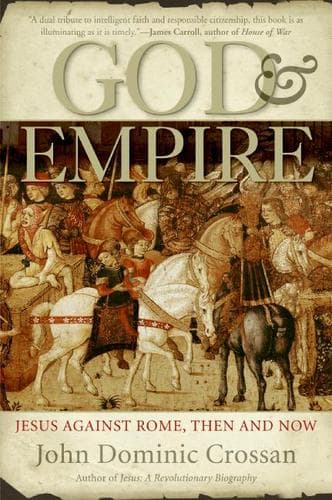
God and Empire
الله والإمبراطورية
Dieu et l'empire
Editorial summary
Crossan's God and Empire: Jesus Against Rome, Then and Now presents a provocative theological-political analysis that contrasts the Kingdom of God proclaimed by Jesus with the imperial ideology of Rome, drawing explicit parallels to contemporary American foreign policy. The work argues that early Christianity emerged as a radical counter-imperial movement, offering an alternative vision of power based on distributive justice and nonviolence rather than military conquest and economic exploitation.
The monograph employs a multidisciplinary methodology, weaving together historical Jesus research, Roman imperial studies, and contemporary political theology. Crossan examines how Rome legitimated its power through religious ideology, presenting the emperor as divine and the empire as the bringer of peace and civilization. Against this backdrop, he interprets Jesus's proclamation of God's Kingdom as a deliberate subversion of imperial theology. Where Rome promised peace through victory, Jesus proclaimed peace through justice. Where Caesar claimed divine authority through violence, Jesus revealed God's nature through healing and table fellowship with outcasts.
Central to Crossan's argument is his analysis of divergent eschatological visions within early Christianity. He distinguishes between the nonviolent eschatology of Jesus and the violent apocalypticism found in texts like Revelation, arguing that Christianity has struggled throughout its history with these competing visions of how God acts in history. This internal tension becomes particularly acute when Christianity itself achieves imperial power, as it did under Constantine and arguably does in contemporary America.
The work explicitly challenges what Crossan identifies as American imperial theology, particularly the conflation of divine will with national interest in foreign policy discourse. He argues that when religious language sanctifies military intervention and economic domination, it represents a fundamental betrayal of the gospel's anti-imperial message. This critique extends to Christian communities that uncritically support imperial policies while claiming biblical authority.
Crossan's contribution to the God debate lies in his demonstration of how conceptions of divine action and authority inevitably carry political implications. By showing how early Christianity's understanding of God emerged in direct opposition to imperial theology, he challenges both apolitical spirituality and the theological legitimation of empire. The work insists that authentic Christian faith requires recognizing God's preferential option for justice over power, persuasion over coercion, and the cross over the sword.
Argument formulations engaged
Crossan, John Dominic (2007). God and Empire.
@book{god-and-empire-2007,
  author    = {Crossan, John Dominic},
  title     = {God and Empire},
  year      = {2007},
  url       = {https://god-database.com/en/works/god-and-empire-2007}
}