
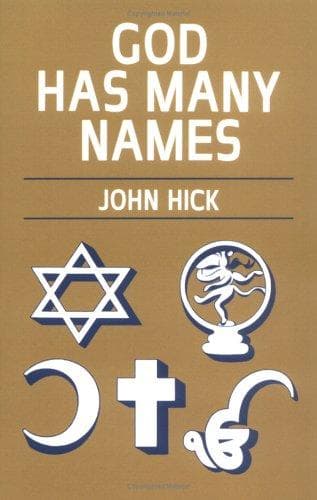
God Has Many Names
لله أسماء كثيرة
Dieu a plusieurs noms
Editorial summary
This monograph represents John Hick's mature articulation of religious pluralism, developing his influential thesis that the world's major religions constitute different culturally conditioned responses to the same ultimate transcendent Reality. Writing in 1980, Hick advances beyond his earlier Christian-centered inclusivism toward a more radical pluralist position that challenges traditional claims to religious exclusivity.
Hick constructs his argument through both philosophical analysis and comparative religious studies. He begins by examining the epistemological problem of religious diversity: if religious experience provides evidence for divine reality, how should one interpret the conflicting truth claims arising from different traditions? Rather than dismissing non-Christian religions as false or viewing them as incomplete versions of Christianity, Hick proposes that all major faiths represent authentic encounters with the Real, though mediated through distinct conceptual frameworks and cultural forms.
Central to Hick's thesis is his distinction between the Real an sich (borrowing Kant's noumenal-phenomenal distinction) and the Real as humanly experienced. He argues that the infinite transcendent Reality necessarily appears to finite human consciousness through various religious lenses—personal deities like Yahweh, Allah, or Vishnu in theistic traditions, or impersonal absolutes like Brahman, Dharmakaya, or the Tao in non-theistic systems. These diverse manifestations reflect not the capricious nature of the divine but rather the inevitable plurality of human religious conceptualization.
Hick addresses the challenge of conflicting truth claims by proposing a soteriological criterion: authentic religions facilitate the transformation of human existence from self-centeredness to Reality-centeredness. This pragmatic approach sidesteps metaphysical disputes while maintaining that religions can be evaluated by their spiritual and ethical fruits. He examines salvation concepts across traditions, arguing that despite terminological differences, all major faiths promote essentially similar transformative processes.
The work engages critically with both religious exclusivists who claim unique access to divine truth and secular critics who view religious diversity as evidence against religious truth altogether. Hick's pluralist hypothesis offers a middle path, maintaining the cognitive significance of religious belief while rejecting claims to exclusive revelation.
This monograph proved highly influential in philosophy of religion, establishing religious pluralism as a major position in theological discourse. While critics challenge Hick's apparent reductionism and question whether his Real bears meaningful content, his work fundamentally shifted debates about religious diversity, making pluralism a serious option alongside exclusivism and inclusivism in contemporary theology.
Argument formulations engaged
Related works
Hick, John (1980). God Has Many Names. Macmillan.
@book{god-has-many-names-1980,
  author    = {Hick, John},
  title     = {God Has Many Names},
  year      = {1980},
  publisher = {Macmillan},
  url       = {https://god-database.com/en/works/god-has-many-names-1980}
}